
Where the Rivers Wear Scales - Bali
The Naga Carved into Bali’s Living Stone
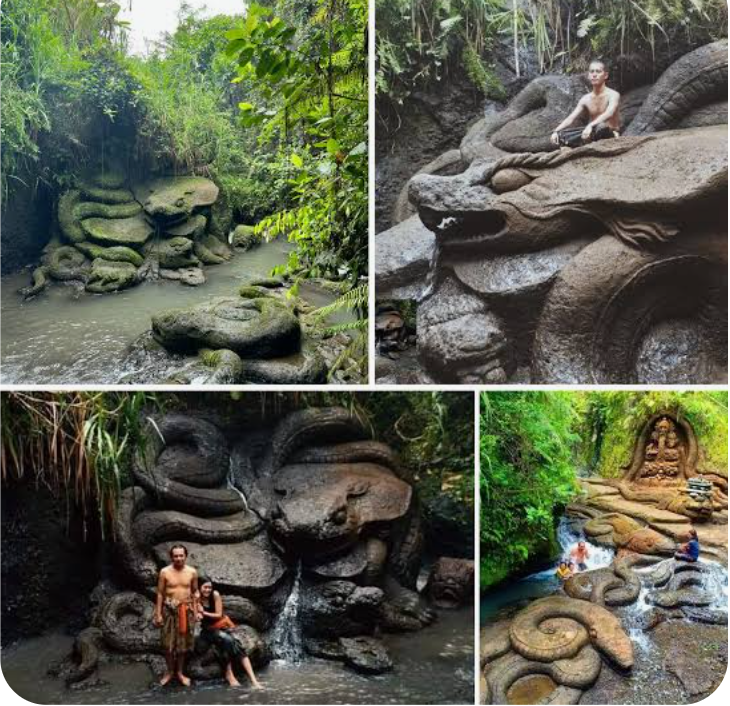
In Bali, stone does not always feel still.
Along temple stairways, beside sacred water, and among walls darkened by rain and moss, serpents emerge from the architecture. Their bodies curl through carved stone, their mouths open beneath elaborate crowns, and their scales seem almost to move when tropical light passes across them.
These are the naga — the great serpents woven deeply into the religious imagery of Bali.
They are not merely dragons placed upon a building for decoration. In traditional Balinese sacred architecture, the naga can represent the earth itself, water, flowing rivers, clouds and even the rainbow. Their presence connects the built world to the natural one surrounding it. “Jurnal ISI Surakarta”
That relationship makes particular sense on an island where water has always meant far more than scenery.
Springs emerge from volcanic ground. Rivers cut deep ravines through the landscape. Rice fields depend upon intricate systems of irrigation, while temples and sacred places developed around sources of water that carried both practical and spiritual importance.
Here, mythology did not need to be separated from the landscape.
It could simply be carved into it.
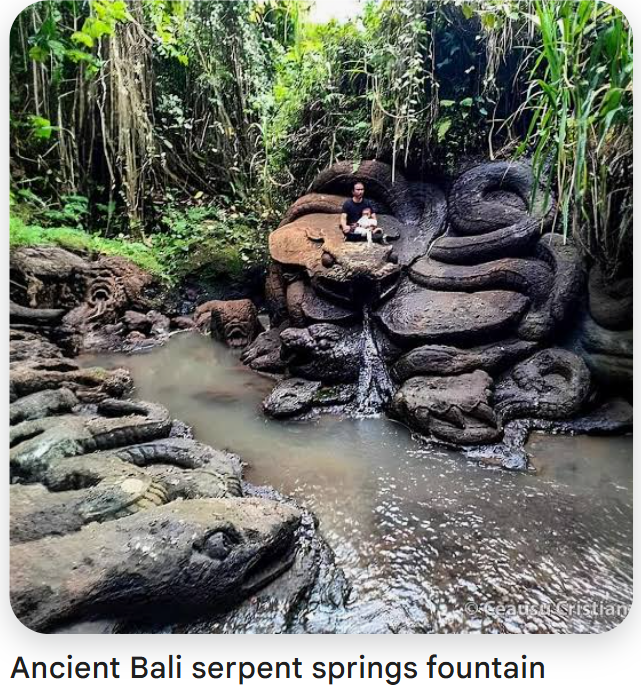
Serpents Beneath the World
The naga belongs to a much older religious tradition extending through Hindu and Buddhist cultures of South and Southeast Asia. Usually imagined as an enormous serpent or serpent-like supernatural being, naga are closely associated with water, fertility, protection and the hidden world beneath the earth.
Bali gave those ancient ideas its own visual language.
Naga became part of sacred architecture — not creatures confined to manuscripts or stories, but enormous stone presences incorporated into temples themselves.
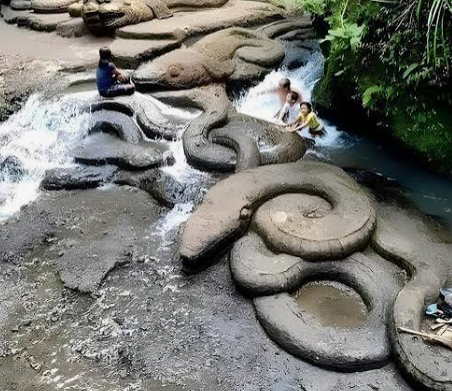
A staircase might descend between their bodies.
A gateway might be guarded by them.
A shrine might incorporate their curling forms.
And near water, the symbolism becomes almost literal: the serpent becomes the river.
Research into traditional Balinese sacred architecture identifies the naga with earth, water and the flow of rivers, among several other natural and cosmological meanings. “Jurnal ISI Surakarta”
It is a beautiful idea.
Perhaps the river does not merely belong to the naga.
Perhaps the river is the naga.

Stone Beside Sacred Water
The landscape around Bedulu, near Ubud, offers one of the most remarkable examples of how intimately ancient Balinese carving, water and landscape became intertwined.
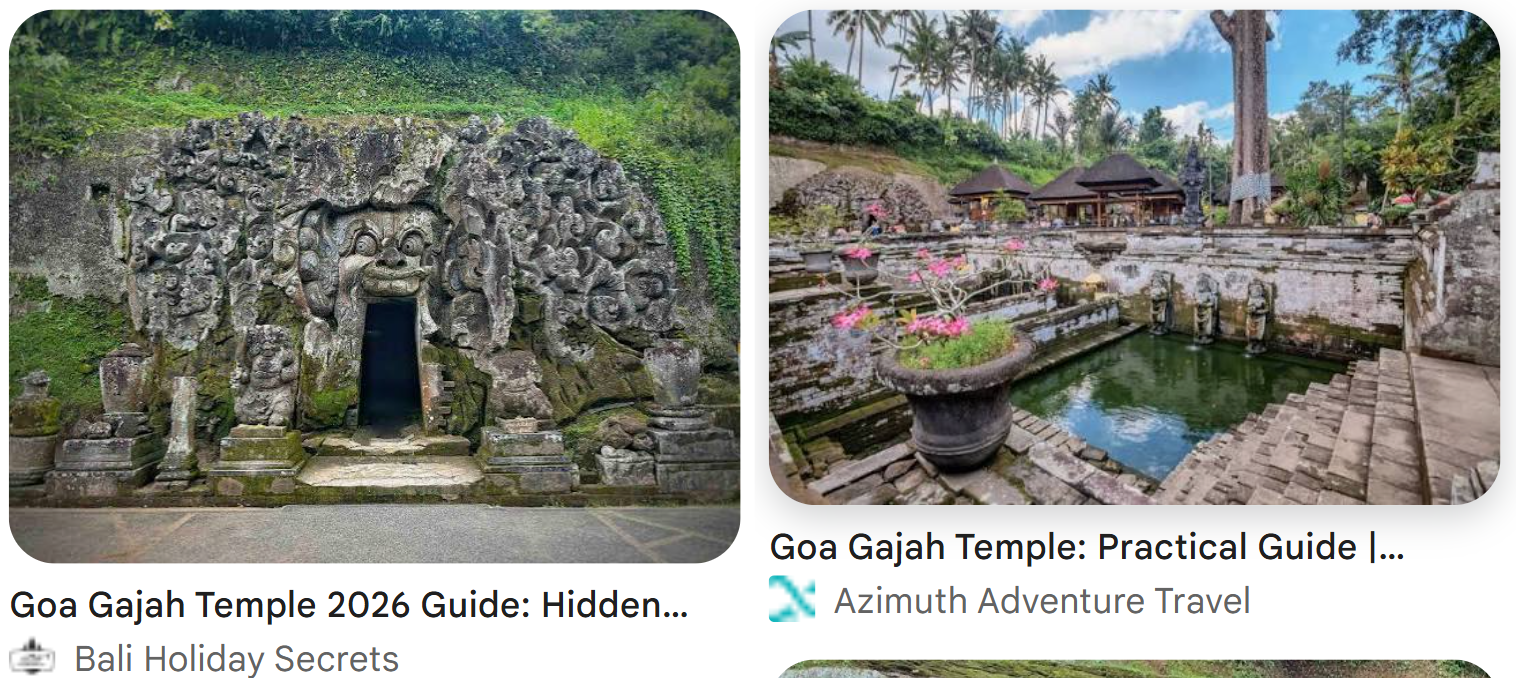
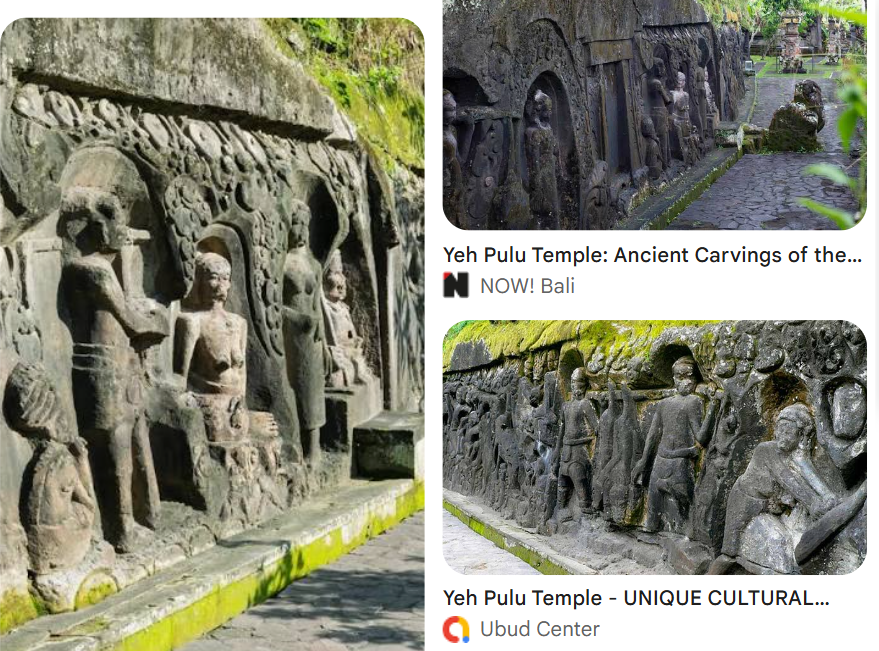
Here stand Goa Gajah, the famous Elephant Cave sanctuary, and nearby Yeh Pulu, where an extraordinary relief was carved directly into the rock face centuries ago.
Yeh Pulu stretches approximately 25 meters along a cliff in a ravine near the Petanu River. The relief is generally dated to around the fourteenth or fifteenth century and depicts scenes of human life—people carrying vessels, hunting, working and interacting — along with animals and the Hindu deity Ganesha. A meditation cave lies at the end of the relief, and a holy spring is part of the site. “NOW! Bali”

Even its name carries water within it.
Yeh means water, while pulu refers to a vessel or container — a reference to the spring associated with the site. “Dinas Pariwisata Kabupaten Gianyar”
The carvings are not objects that were made somewhere else and later displayed there.
They belong to the cliff.
They were cut directly into it.
That distinction matters.
A museum can move a statue from one room to another. A collector can carry an artifact across an ocean. But a relief carved into the side of a ravine remains tied to the earth from which it was made.
It is simultaneously artwork, landscape and archaeological record.
That is why these places feel less like collections of ancient objects and more like something still inhabiting the land.
Not Forgotten — Rediscovered
Yeh Pulu is sometimes described as having been “discovered” in 1925, when it came to the attention of colonial-era researchers and was later excavated by the Dutch archaeological authorities.
But discovered is a dangerous word.
The site existed within a Balinese landscape inhabited by people who had lived around its rivers, fields and sacred places for generations. What occurred in the twentieth century was its documentation and recognition by outsiders and archaeological authorities — not the moment Bali suddenly learned the cliff was there. “NOW! Bali”
The stone had been waiting much longer than that.
And perhaps that is part of what makes Bali's ancient carved landscapes so compelling.
Centuries pass.
Kingdoms disappear.
Religions evolve and absorb older traditions.
Names change.
Paths become overgrown and are cleared again.
Yet the stone remains.
Where Myth Meets the River
The naga carved throughout Bali's sacred architecture belong naturally in this world.
They represent something larger than a mythical creature.
They embody the relationship between people and the forces that sustain them — the earth beneath their feet, the clouds above them, and particularly the water moving between the two.
That may be why a moss-covered naga beside a Balinese temple can feel strangely alive.
Rain gathers in the grooves of its scales.
Roots creep across the stone.
Moss settles into the lines carved by hands centuries ago.
Water continues downhill toward the river.
The sculptor is gone.
The kingdom that surrounded him is gone.
But the serpent remains exactly where it was placed, slowly becoming part of the landscape it was meant to represent.
And perhaps that is the most beautiful thing about Bali's naga.
They were never really carved onto the landscape.
They were carved from it.
#GothicDustDiaries #RelicsOfTime #Bali #Naga #BalineseCulture #AncientCarvings #SacredPlaces #AncientHistory #Mythology #HinduMythology #SacredArchitecture #HiddenHistory #Archaeology #GoaGajah #YehPulu #Indonesia