
An Angel Who Could No Longer Stand
Grieving Husband, Fallen Angel, and a Monument That Gave Heartbreak a Permanent Form
In Rome's Non-Catholic Cemetery, among weathered gravestones, ancient walls, and the quiet passage of time, stands a monument unlike most others.
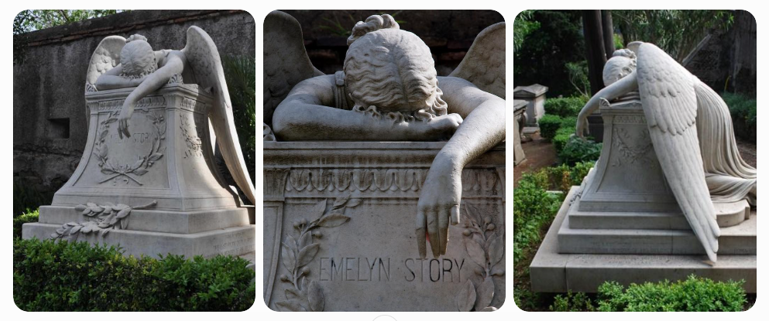
An angel has fallen forward over a tomb.
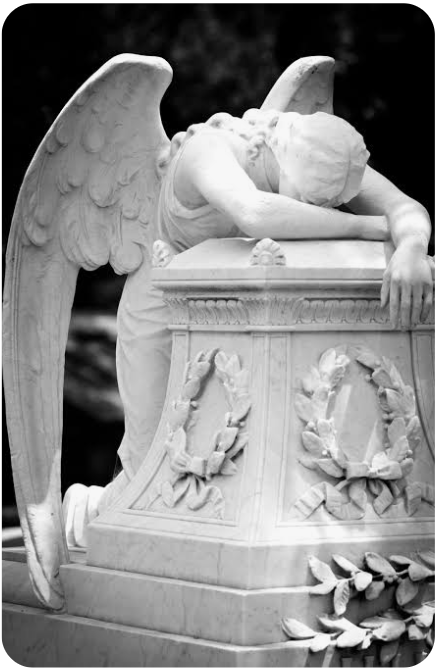
Her wings, ordinarily symbols of heavenly power and protection, hang heavily toward the earth. Her head rests upon her folded arms, concealing her face. One arm extends across the stone, while flowers lie beneath her hand.
There is no triumphant gesture.
No upward gaze toward heaven.
No suggestion that sorrow has been conquered.
Instead, the angel appears utterly defeated by grief.
The sculpture is known as Angel of Grief, although its fuller title is The Angel of Grief Weeping Over the Dismantled Altar of Life.
Created in 1894–1895, it remains one of the most emotionally compelling examples of nineteenth-century funerary sculpture.
And unlike so many monuments whose symbolism can only be interpreted through history, this one carries an intensely personal explanation from the man who created it.
When Grief Became the Inspiration
In January 1894, Emelyn Story died, leaving her husband, American sculptor William Wetmore Story, devastated.
The couple had shared decades of marriage, and a life largely spent in Italy.
Story was already an accomplished sculptor, but this commission was unlike his earlier work. It was not intended for public celebration, artistic recognition, or a wealthy patron.
It was meant for his wife's grave.
In correspondence preserved by later biographers, Story described an angel overcome by grief, her wings lowered and her face hidden against a funeral altar.
He explained the sculpture in four simple words:
“It represents what I feel.”
Those words transform the monument.
The angel is not merely a decorative figure placed upon a grave.
She becomes the physical embodiment of the sorrow that inspired her creation.
And perhaps that is what makes the work so powerful.
Story did not attempt to disguise grief beneath comforting symbolism.
He allowed it to collapse.

The Language of Marble
Look closely at the sculpture.
The wings are extraordinary, not simply because of their craftsmanship, but because of their position.
Angelic wings traditionally suggest flight, protection, spiritual freedom, and a connection between heaven and earth.
Here, they offer no escape.
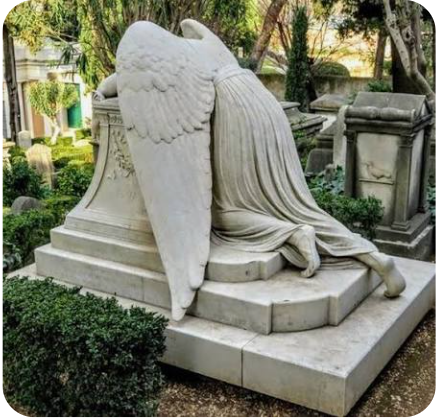
They fall alongside the monument, emphasizing the weight of the figure's sorrow.
The angel's face is concealed.
We cannot see her tears. We cannot determine her expression.
Yet the absence of a visible face makes the emotion strangely universal.
We recognize the gesture without needing to see the features.
The bowed head, the folded arms, the body surrendered to exhaustion—these are expressions of grief that require no translation.
Then there are the flowers.
Flowers have long appeared in funerary art as symbols of beauty, remembrance, love, and life's transience.
In Angel of Grief, they seem almost forgotten beneath the angel's hand.
Whether interpreted as an offering, a symbol of lost beauty, or a reminder of life's fragility, they reinforce the sculpture's atmosphere of abandonment.
And then there is the marble itself.
Cold, pale, and enduring, the stone possesses none of the softness of living flesh.
Yet the sculpted figure appears almost painfully human.
The folds of drapery, the feathered wings, the weight of the body, and the helpless extension of the hand create an emotional contradiction.
Something carved from unyielding stone appears to have surrendered completely.
An Angel Who Offers No Comfort
For centuries, angels appeared in religious and funerary art as messengers, guardians, guides, and symbols of hope.
Many cemetery angels point toward heaven, hold flowers or wreaths, or stand in quiet contemplation.
Their presence often suggests reassurance.
The promise that death is not the end.
The possibility of reunion.
The belief that someone watches over those who have departed.
But Angel of Grief reverses that familiar relationship.
Rather than comforting the bereaved, the angel is herself inconsolable.
She does not stand above human sorrow.
She shares it.
There is something profoundly moving about that reversal.
The sculpture does not tell us that everything will be all right.
It does not promise that time will heal every wound.
Instead, it acknowledges an emotion that people throughout history have struggled to express.
Sometimes grief is so overwhelming that even the strongest among us cannot remain standing.
And in this monument, even an angel has reached that point.
The Altar of a Broken Life
The sculpture's full title deserves attention.
The Angel of Grief Weeping Over the Dismantled Altar of Life.
An altar ordinarily represents devotion, sacrifice, reverence, or something held sacred.
But here, the altar has been dismantled.
The title suggests more than mourning a single death.
It evokes the collapse of an entire world—the loss of the person around whom one's daily life, hopes, memories, and future had been built.
For the grieving, death can change the meaning of familiar places and ordinary routines.
A chair remains empty.
A voice is no longer heard.
Objects once overlooked become precious reminders.
Life continues, but its familiar arrangement has been broken.
That is one interpretation of the dismantled altar: not simply a place of burial, but a symbol of the life that existed before the loss.
And the angel, unable to restore what has been taken, can only grieve.
A Monument That Crossed Oceans
Although the original sculpture stands in Rome, its influence traveled far beyond Italy.
Its unusual depiction of grief captured public attention, and versions of the monument began appearing in cemeteries elsewhere.
One particularly significant reproduction was created for Stanford University in California.
Commissioned as a memorial to Henry Lathrop, the brother of university cofounder Jane Stanford, the sculpture was produced in Italy and transported to California in the early twentieth century.
Other adaptations appeared in cemeteries throughout the United States and beyond.
Not all were exact copies. Some altered proportions, materials, inscriptions, or decorative details.
But the essential image remained recognizable.
The grieving angel.
The lowered wings.
The hidden face.
The overwhelming emotional weight.
What began as one husband's deeply personal memorial had become a visual language through which others could express their own losses.
The Final Work
Angel of Grief was the last major sculpture of William Wetmore Story's career.
He died on October 7, 1895, less than two years after his wife.
He was buried beside her in Rome, beneath the monument he had created.
There is a remarkable poignancy in that fact.
The sculpture began as one person's tribute to another.
In time, it became the memorial to both.
And the angel that represented his sorrow remained behind to guard their resting place.
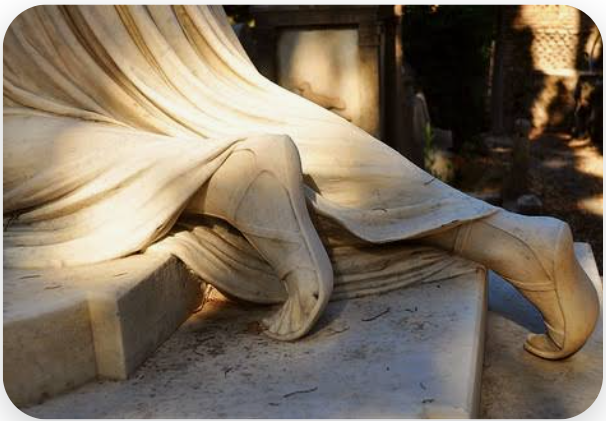
More than a century later, visitors still pause before the monument.
Some admire the extraordinary craftsmanship.
Others photograph its dramatic silhouette.
But many seem drawn to something less easily explained.
The unmistakable humanity of its sorrow.
When Art Speaks Without Words
There is a reason certain works of art remain with us long after we first encounter them.
Sometimes it is their beauty.
Sometimes their historical importance.
Sometimes their technical brilliance.
And sometimes it is because they express something we recognize within ourselves.
Angel of Grief does not require an understanding of sculpture, religious iconography, or nineteenth-century artistic traditions.
Its message is immediately recognizable.
Loss.
Love.
Exhaustion.
The helplessness of being unable to change what has happened.
Yet there is also something beautiful within that sorrow.
Not because grief itself is beautiful, but because the sculpture gives dignity and permanence to an emotion that can feel impossible to endure.
It reminds us that vulnerability is not the absence of love's strength.
Sometimes it is evidence of how deeply someone was loved.
And perhaps that is the extraordinary achievement of Angel of Grief.
A husband created a memorial for the woman he had lost, yet in doing so, he fashioned an image that generations of strangers would understand.
He carved his own sorrow into marble, and somehow gave countless others a place to recognize theirs.
The angel may never lift her head.
Her wings may never rise.
But her grief continues to speak.
And sometimes, the most powerful work of art is not the one that offers an answer.
It is the one that quietly tells us we are not alone in the question.
#AngelOfGrief #WilliamWetmoreStory #GothicArt #FuneraryArt #MarbleSculpture #ArtHistory #Symbolism #GothicDustDiaries #MUSE #PORTFOLIO