
The Painter Who Gave Death a Face
Some artists paint what they see. Others paint what they imagine.
Arnold Böcklin belonged firmly to the second group.
Mythology, mysterious islands, and the Swiss Symbolist who transformed fear and mortality into unforgettable art.
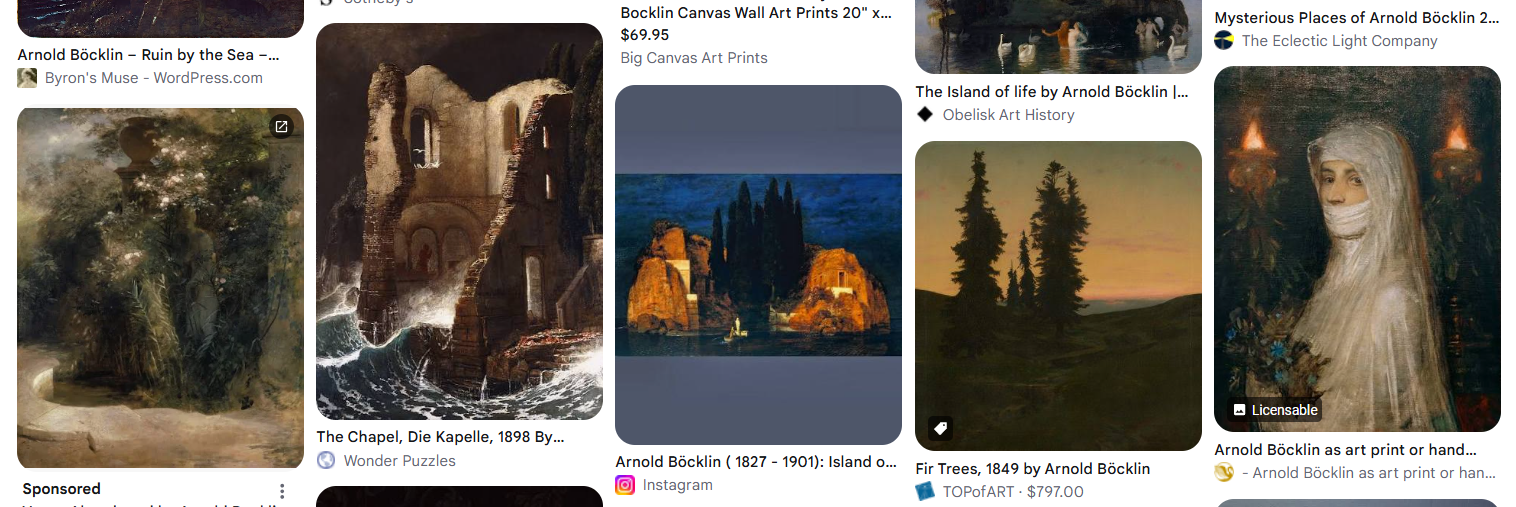
Born on October 16, 1827, in Basel, Switzerland, Böcklin became one of the most distinctive painters associated with nineteenth-century Symbolism. His work combined classical mythology, dramatic landscapes, haunting figures, and an extraordinary ability to suggest that something mysterious existed just beyond the visible world.
He did not simply illustrate ancient legends. He gave them atmosphere, emotion, and an unsettling sense of possibility.
A Life Between Two Worlds
Böcklin studied at the Düsseldorf Academy of Art under the landscape painter Johann Wilhelm Schirmer. His early training emphasized landscape painting, but his travels through Europe—particularly his years in Italy—transformed his artistic imagination.
The ruins, Mediterranean scenery, and classical heritage of Italy offered him a world in which mythology and reality seemed to coexist.
Ancient gods, centaurs, mermaids, sea creatures, and mythical beings gradually populated his canvases.
Yet his paintings were rarely straightforward celebrations of antiquity. Beneath their beauty often lay melancholy, uncertainty, or danger.
A peaceful landscape might contain a disturbing figure. A mythological creature might seem strangely human. A seemingly ordinary scene could suggest an invisible presence.
Böcklin understood that the imagination could make the familiar extraordinary.
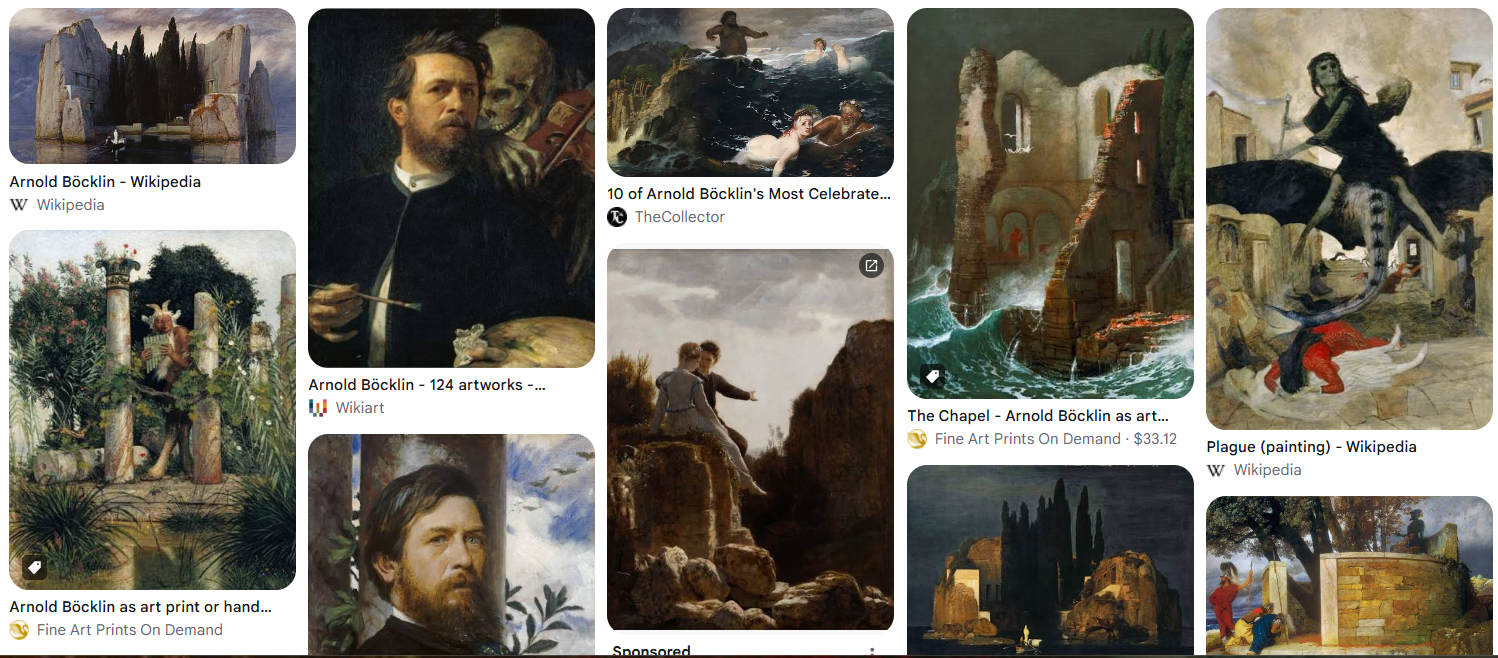
Beauty, Loss, and Mortality
Death was not merely an artistic subject for Böcklin. It was also a presence in his personal life.
He and his wife, Angela Pascucci, experienced the deaths of several of their children, losses that formed part of a life marked by financial difficulties, illness, and repeated moves.
Although it would be too simple to attribute his artistic fascination with mortality entirely to personal tragedy, the themes of death, remembrance, and the unknown became central to some of his most memorable works.
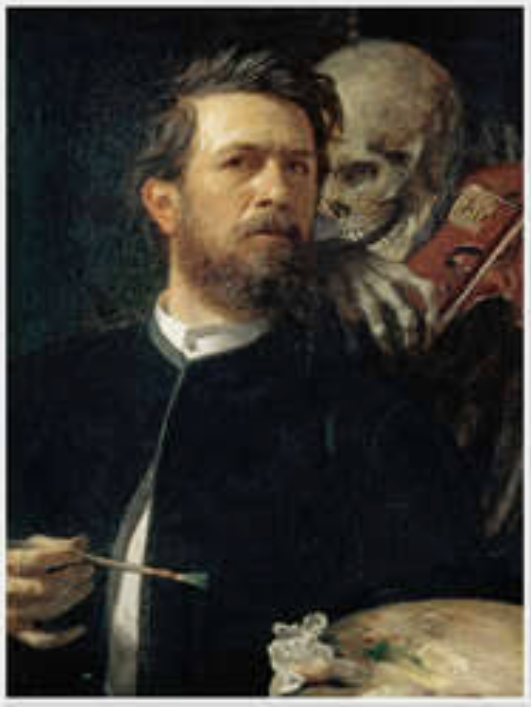
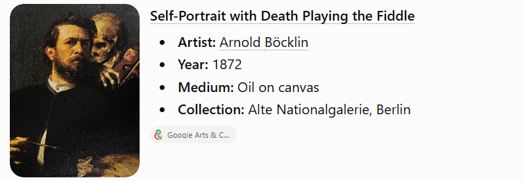
In 1872, he painted Self-Portrait with Death Playing the Fiddle.
The artist appears before his canvas while a skeletal figure stands behind him, playing a violin with only one string remaining.
Böcklin seems to listen.
The image draws upon the traditions of memento mori—the reminder that human life is temporary—and the medieval Dance of Death.
But the painting also raises a more personal question.
Is Death warning the artist that his time is running out, or reminding him that creation itself is an answer to mortality?
The Island That Refused to Be Forgotten
Perhaps Böcklin's most celebrated creation is Isle of the Dead, a haunting composition he painted in five versions between 1880 and 1886.
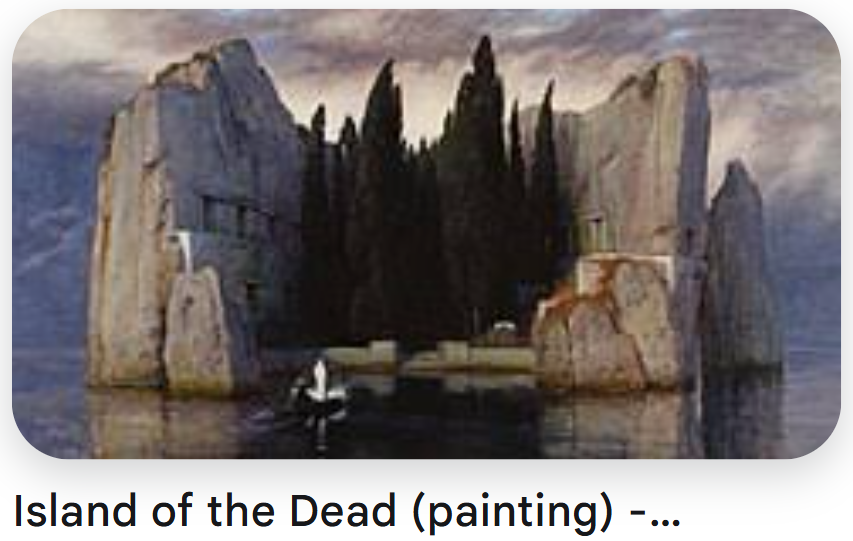
A small boat approaches a mysterious island surrounded by dark water. Towering cypress trees rise between monumental rock formations. A white-clad figure stands beside what appears to be a coffin.
There is no dramatic action.
No visible struggle.
Only silence, stillness, and the suggestion of a final journey.
Böcklin did not provide a definitive explanation of the scene, leaving generations of viewers to interpret its meaning.
The painting became extraordinarily influential, inspiring writers, composers, and artists. Sergei Rachmaninoff composed his symphonic poem The Isle of the Dead after encountering a reproduction of the image.
Its power lies partly in what it refuses to reveal.
We do not know precisely where the boat is going, who is being carried, or what awaits beyond the island's entrance.
And perhaps that uncertainty is exactly why the painting continues to haunt us.
A Legacy Beyond Symbolism
Böcklin died on January 16, 1901, in Fiesole, Italy.
His artistic influence, however, extended far beyond his lifetime.
His dreamlike imagery and mysterious landscapes helped shape the visual language of Symbolism and influenced later artists, including Giorgio de Chirico and Salvador Dalí.
His paintings also demonstrated that art did not have to explain itself completely to leave a lasting impression.
Sometimes a strange landscape, a silent figure, or a skeleton holding a violin could communicate more than an elaborate narrative.
Böcklin's world was filled with mythology, but his questions were deeply human.
What lies beyond what we can see?
Why are we drawn to things that frighten us?
And how do we reconcile the beauty of life with the certainty that it must end?
Perhaps that is why his paintings remain so compelling.
He did not attempt to remove death from the human experience.
He gave it a place in the picture.
And sometimes, he gave it a violin.
#GothicDustDiaries #ArnoldBocklin #Symbolism #ArtHistory #SwissArtists #IsleOfTheDead #DarkArt #Artists
At some point there will be a cross reference post in PORTFOLIO to interpret “Self-Portrait with Death Playing the Fiddle”