
Myth of the Planetary Parade
When the sky becomes a stage for longing
Every few years, the internet announces it with breathless urgency:
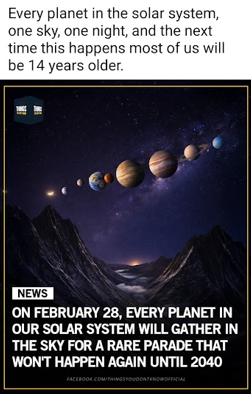
“All the planets will align.”
“A celestial parade.”
“A once-in-a-lifetime sky.”
On February 28, 2026, another such proclamation circulates — promising a rare planetary gathering.
This time, the event itself is real.
Around that date, six planets — Mercury, Venus, Saturn, Jupiter, Uranus, and Neptune — will appear along the evening sky shortly after sunset. They will not form a perfect line, nor a tight cluster, but a wide arc tracing the Sun’s familiar path across the heavens.
It is called a planetary parade.
But astronomy is quieter than the headlines.
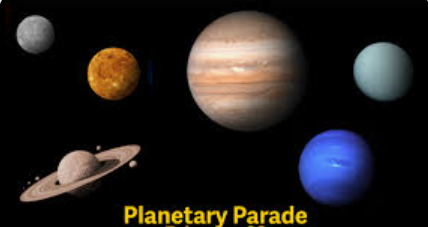
The planets are not assembling in space like beads drawn onto a string. They are simply occupying similar positions along the ecliptic — the flat orbital plane in which the solar system moves. From Earth, this shared plane creates the appearance of alignment.
The solar system itself is a vast, flattened disk of motion — each planet bound to the Sun, traveling along roughly the same invisible plane. From our vantage point, that plane becomes a narrow celestial corridor, and when several worlds happen to drift into that corridor at once, we call it a gathering.
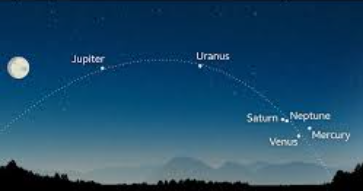
And yes — the solar system is, in fact, a flattened disk.
Well… unless you are a flat earther. In that case, we may need to redraw the cosmos on a dinner plate and start again.
But for the rest of us, what we are witnessing on February evenings is geometry, not prophecy.
Not an omen.
Not a cosmic summit.
Not the heavens holding their breath.
Simply motion intersecting with our line of sight.
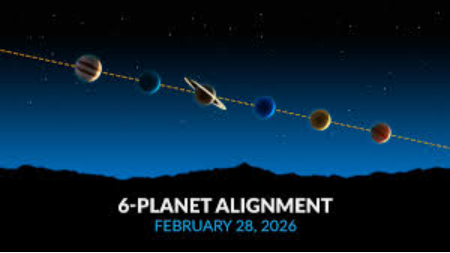
Planetary parades are not unprecedented. They occur periodically, in varying combinations. What makes this one notable is the number visible within a short window after sunset — several with the naked eye, others requiring binoculars or a telescope.
The exaggeration lies not in the sky — but in the storytelling.
Ancient cultures watched planetary groupings with reverence and dread. In Mesopotamia, unusual celestial convergences were read as warnings to kings. In medieval Europe, alignments were whispered about in connection with famine and divine displeasure.
Today, social media packages them as spectacle. Dramatic graphics depict glowing worlds stacked in flawless formation. Headlines promise rarity. Spiritual commentary assigns cosmic meaning.
Gravity, however, remains unmoved by symbolism.
The planets are always in motion. Always shifting. Always forming new visual relationships as Earth itself moves between them.
The sky does not rearrange itself for us.
But we long for it to.
We want the cosmos to synchronize visibly.
To gather.
To signal that something extraordinary is unfolding in our lifetime.
February 28, 2026 will not deliver a perfect line of eight planets suspended across the sky.
What it will offer — weather permitting — is subtler and no less beautiful: six worlds tracing a luminous arc after sunset, a reminder that we live inside a dynamic system whose patterns unfold over years, not headlines.
Perhaps the myth of the planetary parade tells us less about astronomy and more about human longing.
The rarest event may not be the alignment.
But the attention we give it.
#ArcaneMusings #GothicDustDiaries #PlanetaryAlignment #PlanetParade #AstronomyFacts #CelestialEvents #SolarSystem #SpaceMyths #CosmicWonder #AstronomyExplained #Ecliptic #ModernMyth #DigitalFolklore #NightSky