
An Ordinary Garage-Sale Find Concealed a Thousand-Year-Old Chinese Treasure
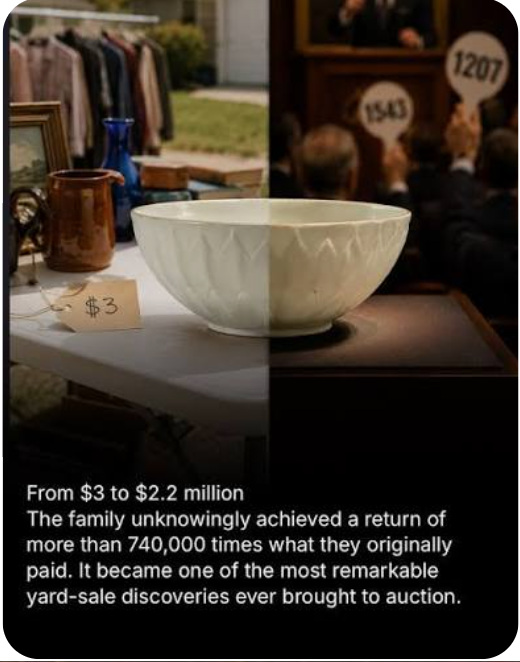
Imagine wandering through a neighborhood garage sale, browsing tables filled with forgotten household belongings, and spotting a small white bowl.
Nothing particularly remarkable about it. No glittering gemstones. No elaborate gold decoration. Nothing suggesting extraordinary wealth.
The asking price? Just three dollars.
You take it home, place it on a shelf, and go about your life.
Years later, you discover that the humble little bowl is worth more than two million dollars.
Sounds impossible?
In 2007, that is exactly how one of the most remarkable antique discoveries of modern times began.
A Three-Dollar Treasure
An unidentified family in New York purchased a small, ivory-colored ceramic bowl at a local tag sale.
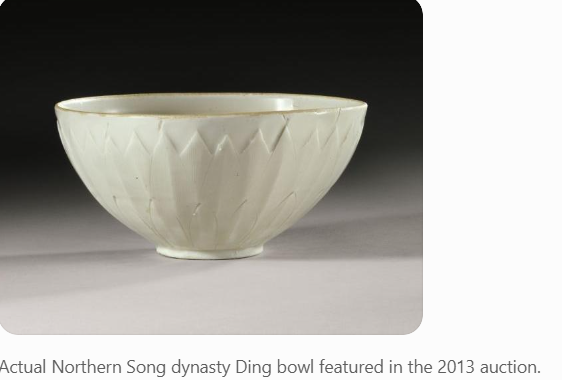
Measuring approximately five inches across, the bowl was attractive but understated. Its delicate glaze and subtle carved decorations certainly suggested craftsmanship, but nothing about its appearance announced that it was a museum-quality antiquity.
The family took it home and displayed it in their living room.
And there it remained.
For several years, one of the rarest surviving examples of ancient Chinese ceramics sat quietly among ordinary household possessions.
Its owners had no idea what they had found.
A Thousand Years of History
Eventually, curiosity got the better of the family, and they decided to have the bowl examined.
What experts discovered was extraordinary.
The little vessel was an authentic example of Ding ware, a highly prized form of Chinese porcelain associated with the Northern Song dynasty, which ruled from 960 to 1127.
Ding ceramics were admired for their refined shapes, delicate craftsmanship, and beautiful ivory-white glazes.
Unlike heavily decorated pottery, these pieces often relied upon subtlety. Fine carvings, carefully controlled proportions, and elegant surfaces distinguished the work of exceptionally skilled artisans.
The garage-sale bowl featured delicate floral and leaf decorations, with intricate carving on both its interior and exterior.
But its age was only part of the story.
According to Sotheby's, only one other bowl of nearly identical form, size, and decoration was known to exist.
That example belonged to the British Museum in London.
Imagine discovering that your three-dollar purchase had a close counterpart in one of the world's most famous museums!
Identification
Interestingly, Sotheby's catalogue did not identify a maker's mark on the bowl. Its extraordinary origins were recognized through its delicate porcelain, distinctive ivory-colored glaze, intricate carving, and similarities to known examples from the Northern Song dynasty.
The bowl's appearance and craftsmanship told a story that no signature was needed to reveal.
Sometimes, the absence of a maker's mark doesn't mean an object has no history. It simply means knowing what to look for becomes even more important.
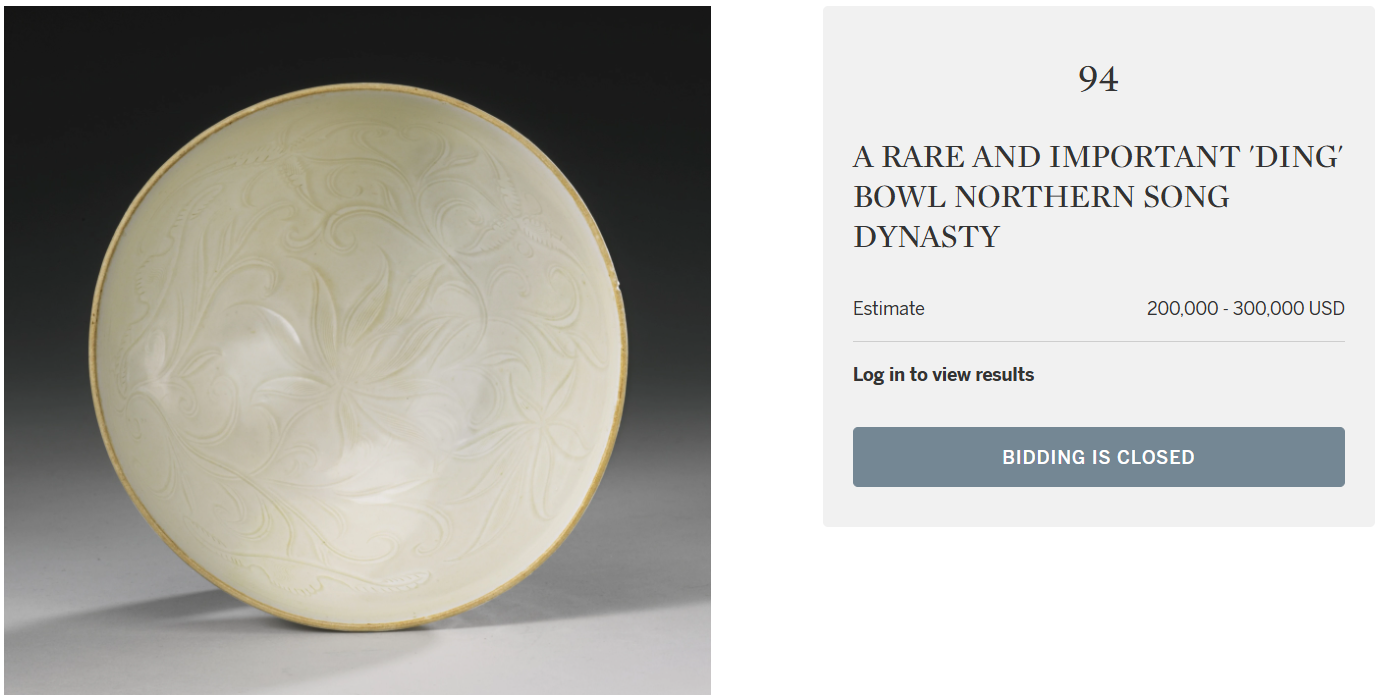
Here's the original catalogue so you can examine the details yourself:
From the Living Room to Sotheby's
Once its identity was established, the bowl was entrusted to Sotheby's in New York.
The auction house estimated that it would sell for between $200,000 and $300,000.
Already, the discovery was almost unbelievable.
A family that had paid no more than three dollars for an ordinary-looking bowl was suddenly preparing to offer it at an auction where collectors might spend hundreds of thousands of dollars.
But even Sotheby's had underestimated the enthusiasm the little vessel would inspire.
On March 19, 2013, the bowl went under the hammer.
Four determined bidders competed for it, pushing the price far beyond its original estimate.
When the bidding finally ended, the winning buyer was renowned London art dealer Giuseppe Eskenazi.
The final price, including the buyer's premium, was $2,225,000.
From three dollars to more than two million.
Not an exaggerated appraisal. Not an ambitious asking price.
An actual, documented auction sale.
The Beauty of an Unexpected Discovery
What makes this story so fascinating isn't simply the money.
It's the extraordinary journey of the object itself.
Nearly a thousand years earlier, an unknown Chinese artisan had shaped and decorated a small porcelain bowl.
It survived the passing of dynasties, generations of owners, and centuries of history.
Somehow, it eventually crossed oceans and continents before finding its way onto a garage-sale table in New York.
How did it get there?
Who owned it before the family purchased it?
How many people handled it without recognizing its significance?
The publicly reported history does not answer those questions.
And perhaps that's part of the wonder.
An object that survived almost a millennium became an inexpensive secondhand purchase, only to emerge years later as a treasure of international importance.
What Else Might Be Waiting?
Not every dusty bowl is an ancient masterpiece, of course.
Most garage-sale discoveries are exactly what they appear to be: ordinary objects looking for new homes.
But occasionally, something extraordinary slips through the cracks.
A painting mistaken for a reproduction.
A forgotten piece of jewelry tucked inside an old box.
A ceramic bowl whose quiet elegance conceals a thousand years of history.
And somewhere, someone may be walking past the discovery of a lifetime without giving it a second glance.
The family who purchased that little white bowl couldn't have imagined what would happen when they paid three dollars for it.
Yet years later, their modest purchase became one of the most astonishing garage-sale success stories ever documented.
Which leaves us with a rather irresistible thought.
The next time you wander through a thrift shop, flea market, or garage sale, take another look at that unassuming object sitting in the corner.
You never know what story it might be waiting to tell.
And who knows?
Perhaps the next million-dollar treasure is sitting on someone's kitchen shelf right now.
Gothic Dust Diaries — MUSE | SERENDIPITY
Where extraordinary fortunes emerge from the most unexpected discoveries.
#GothicDustDiaries #Muse #Serendipity #HiddenTreasures #GarageSaleFinds #ChineseAntiques #DingWare #SongDynasty #Sothebys #ArtHistory #AntiqueDiscoveries #UnexpectedFortunes #ForgottenHistory