
THE RIME OF THE ANCIENT MARINER
A Review of: THE RIME OF THE ANCIENT MARINER
Before ghost ships became a familiar image of maritime imagination, Samuel Taylor Coleridge gave literature one of its most unforgettable vessels: a ship suspended between punishment and mercy, drifting through unnatural waters under the burden of one irreversible act.
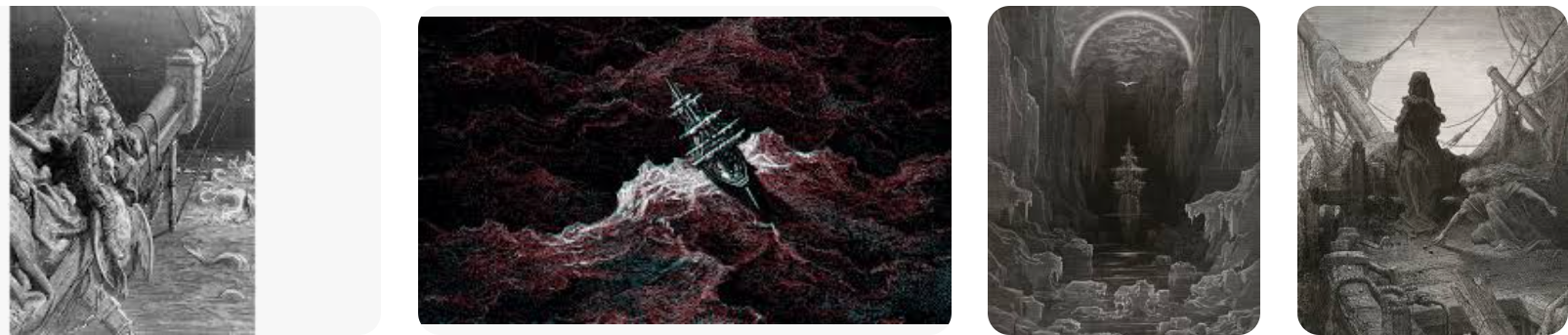
Published in 1798, The Rime of the Ancient Mariner follows an old sailor who stops a wedding guest and compels him to hear a story he cannot stop retelling. The mariner speaks not as a hero, but as someone marked by survival—one who has returned from a voyage where nature, conscience, and the supernatural became impossible to separate.
The turning point comes when he kills an albatross, a bird long associated by sailors with guidance and fortune. The act appears senseless, almost casual, yet the consequences begin almost immediately. Wind dies. The ship stalls. Heat presses down over motionless water. Around them lies abundance that cannot sustain life: endless sea, yet no drinkable drop.
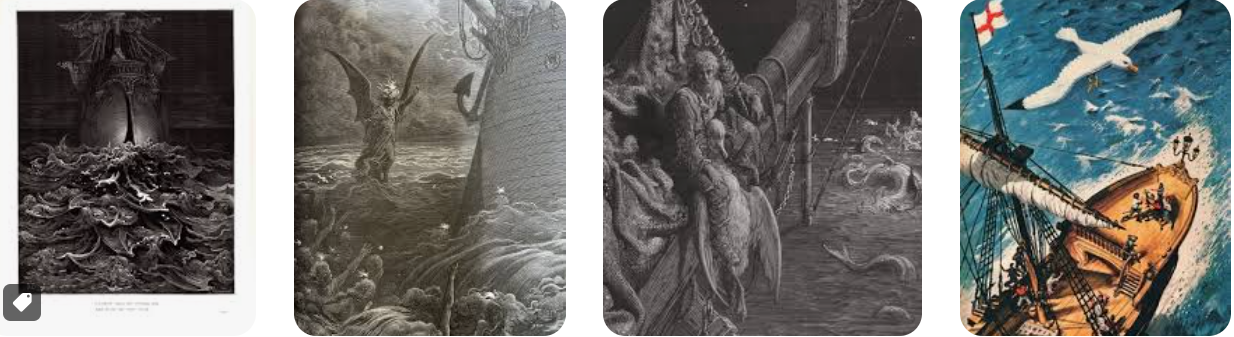
One by one, the crew dies, and the mariner remains alive among the dead, forced to witness what his own hand has invited. The dead do not simply disappear from the poem; they remain present, creating one of the most unsettling atmospheres in maritime literature—silence broken only by dread and the slow passage of consequence.
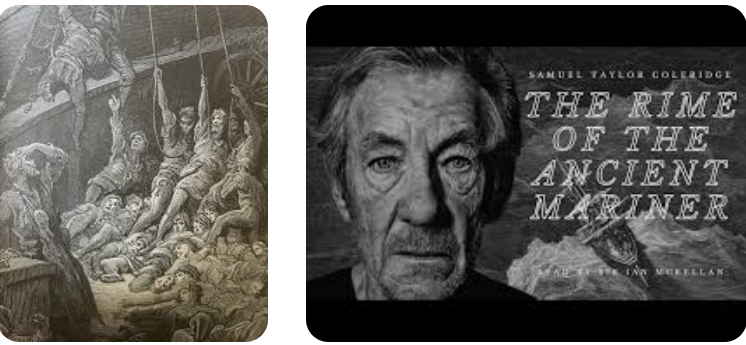
The image of the albatross hung around his neck became one of literature’s enduring symbols: guilt made visible, carried openly where all can see it. Even now, when people speak of “an albatross around one’s neck,” they are repeating a burden first given shape by Coleridge.
What makes the poem so enduring is that the sea is never just setting. It behaves almost like a witness—vast, patient, and morally charged. The ship drifts not simply through weather, but through judgment. Strange lights appear, spectral presences emerge, and survival itself becomes less a victory than a sentence.
Yet the poem is not entirely without grace. The mariner eventually finds a fragile path toward release, not by forgetting what happened, but by learning reverence for life itself. The telling of the tale becomes part of that sentence: he must continue speaking, and others must listen.
That is why the poem still belongs naturally among Gothic works. It is not merely about storm or superstition. It is about what happens when one act disturbs the invisible order of things—and how even calm water can become a place of reckoning.
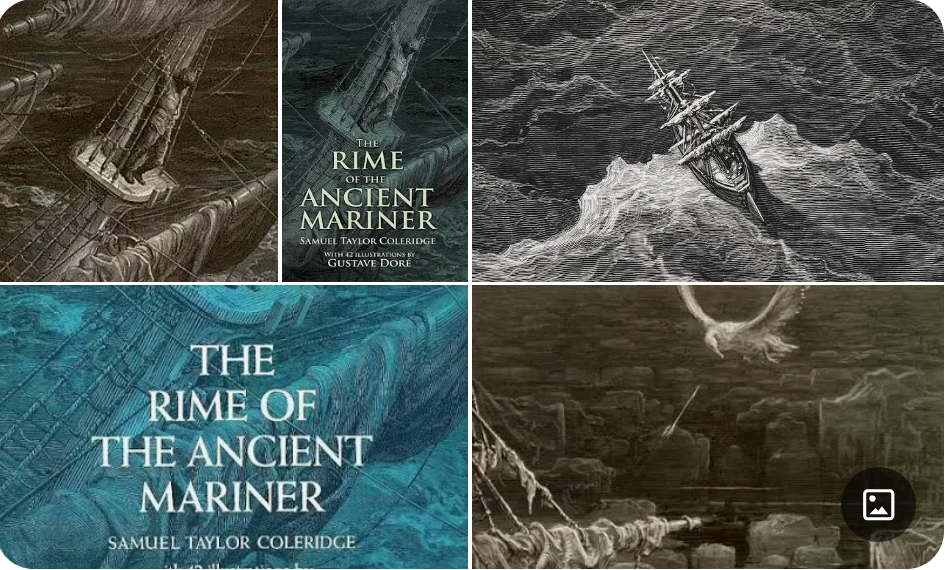
The poem’s atmosphere proved so visually powerful that it inspired several film adaptations over the years, though most remained closer to narrated visual interpretations than conventional cinema. Rather than rewriting the story, many versions preserved Coleridge’s language itself, allowing the haunted stillness, spectral ships, and burden of the mariner’s guilt to remain at the center of the experience.
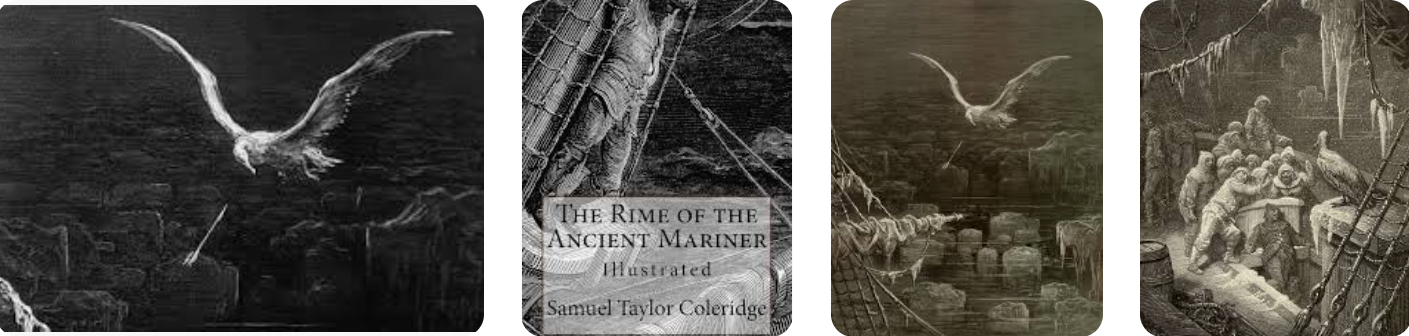
Though often called simply a poem, The Rime of the Ancient Mariner is a full narrative work in seven parts and 625 lines, unfolding through dozens of shifting stanzas. The famous “Water, water, every where” passage appears in Part II, when the sea itself begins to feel like punishment.
A few famous stanzas from
THE RIME OF THE ANCIENT MARINER
Water, water, every where,
And all the boards did shrink;
Water, water, every where,
Nor any drop to drink.
Ah! well a-day! what evil looks
Had I from old and young!
Instead of the cross, the Albatross
About my neck was hung.
#GothicDustDiaries #RimeOfTheAncientMariner #SamuelTaylorColeridge #GothicLiterature #DarkAcademia #MaritimeLore #SeaPoetry #LiteraryGothic #RomanticPoetry #GhostShipAtmosphere #ClassicLiterature #OceanMystery #PoetryAndShadow