
Palazzo Vecchio
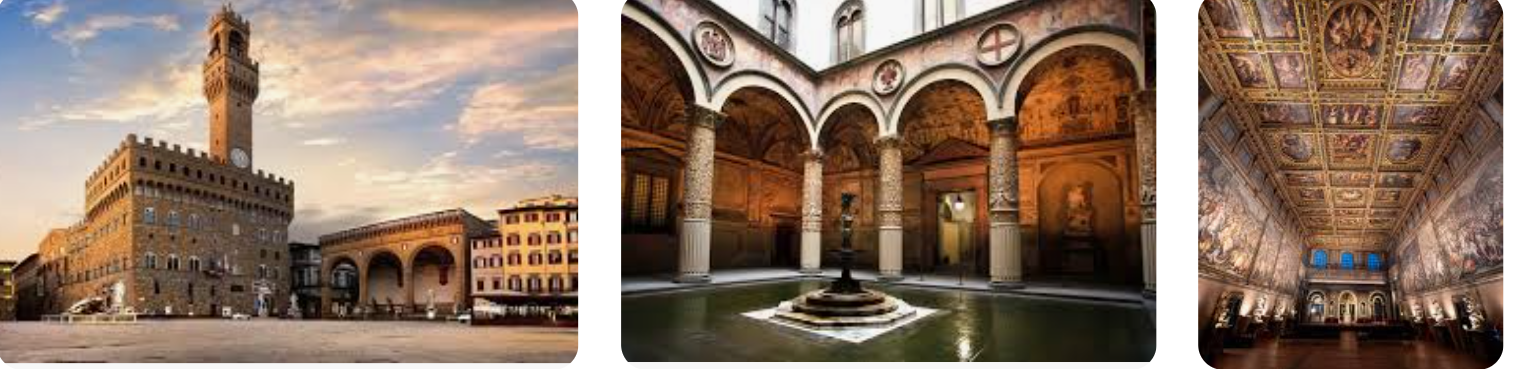
In the heart of Florence, where Renaissance beauty often feels light, lyrical, and humanist, Palazzo Vecchio stands apart. This is not a palace built to charm. It was built to endure, to dominate, and to remind anyone who passed beneath its shadow exactly who held power.
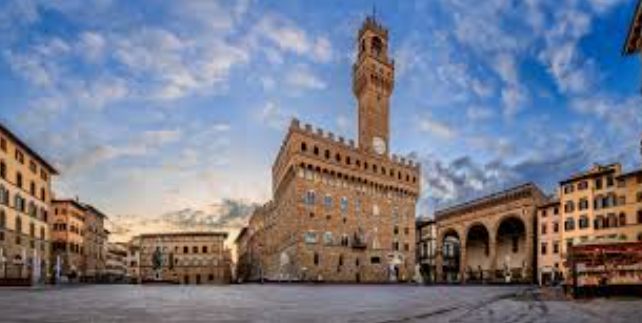
Constructed beginning in 1299, Palazzo Vecchio was designed as Florence’s seat of government—a fortified civic palace meant to protect the ruling body from internal revolt as much as external threat. Its architect, Arnolfo di Cambio, gave it the unmistakable profile of a medieval stronghold: rusticated stone, narrow windows, a crenellated crown, and a soaring tower that seems to watch the city rather than adorn it.
The building’s very name tells a story of political evolution. Originally called the Palazzo della Signoria, it housed the Signoria—Florence’s governing council. Only later, when the Medici family moved their residence to the Pitti Palace, did it become known as the “Old Palace.” But “old” is misleading. Palazzo Vecchio has never been obsolete. It has remained a living center of authority for over seven centuries and still serves as Florence’s city hall today.
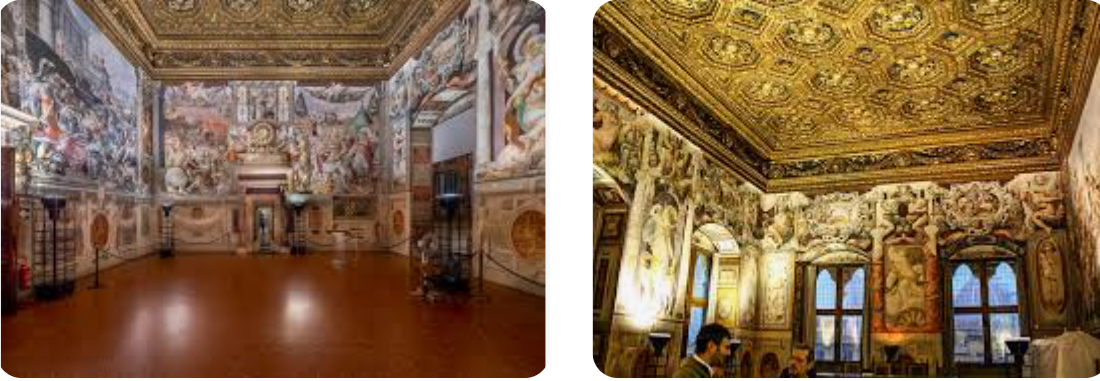
A Fortress with a Public Face
Step into the courtyard and the mood shifts—subtly, but intentionally. Frescoes decorate the walls, celebrating cities under Medici rule. This was diplomacy in paint: a visual declaration that Florence’s influence extended far beyond its walls. Even beauty here is strategic.
Beyond the courtyard lies the Salone dei Cinquecento—the Hall of the Five Hundred—an immense chamber built to house a large republican council after the expulsion of the Medici in 1494. Ironically, when the Medici returned to power, they expanded the hall and transformed it into a stage for their own dominance. Massive frescoes depict Florentine military victories, history rewritten in grand scale and pigment. Legend holds that behind one of these walls may still lie Leonardo da Vinci’s lost Battle of Anghiari, hidden rather than destroyed—politics literally painted over art.
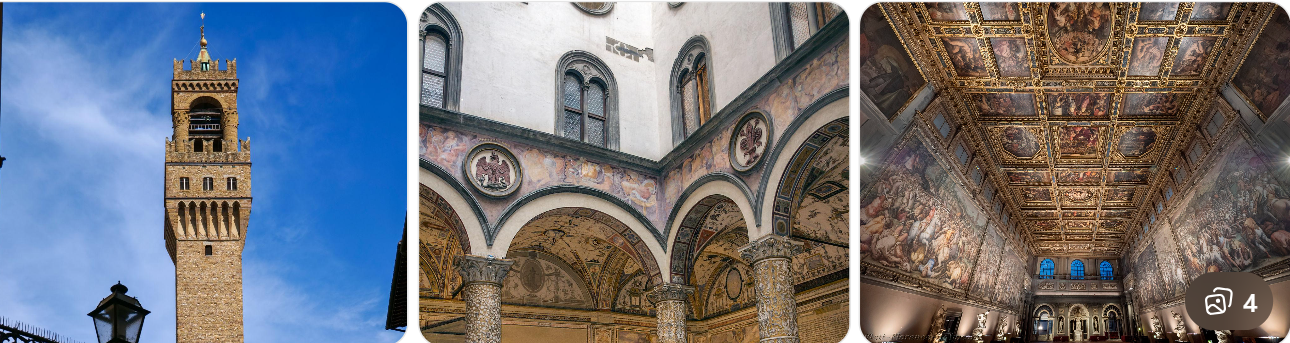
Power Wears Art Like Armor
Palazzo Vecchio is where Renaissance ideals collide with raw authority. Michelangelo, Donatello, and Vasari all left their mark here, but never without purpose. Art in this palace is not decorative—it is declarative. Sculptures, murals, and architectural choices reinforce hierarchy, legitimacy, and control.
The private apartments of Cosimo I de’ Medici tell another side of the story. Lavish ceilings illustrate mythology, astrology, and dynastic symbolism. Even leisure was curated to project inevitability: the Medici were not merely rulers, but ordained by history, cosmos, and culture itself.
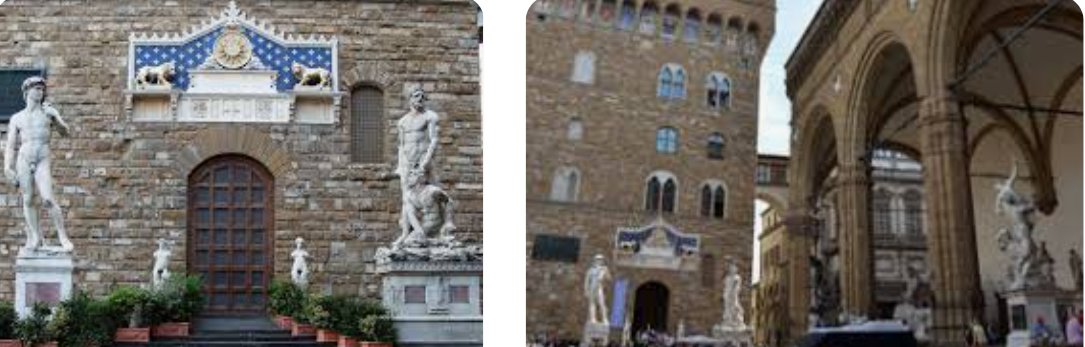
The Tower That Watches
Rising above it all is the Arnolfo Tower, a visual anchor in Florence’s skyline. From its summit, the city unfolds in terracotta and stone, the Duomo visible but not dominant. This is a reminder that civic power once rivaled—and sometimes surpassed—religious authority. From here, Florence was not merely admired; it was governed.
A Living Relic
What makes Palazzo Vecchio truly remarkable is not just its age or artistry, but its continuity. Revolutions have passed through its halls. Republics rose and fell. Families ascended and were exiled. Yet the palace remains in use, adapting without surrendering its identity.
Palazzo Vecchio is Florence stripped of romance and shown in truth: ambitious, intelligent, ruthless when necessary, and endlessly aware that power must be seen to be believed.
#PalazzoVecchio #FlorenceItaly #ItalianHistory #RenaissancePower #Medici #HistoricArchitecture #DarkHistory #GothicItaly #PoliticalHistory #HiddenItaly #GDD