
Peter Pan: Eternal Youth
Peter Pan was never just a children’s story.
https://youtube.com/shorts/HeXmBEK8I2A
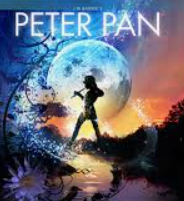
In the dim corridors of Gothic Dust Diaries, Peter Pan emerges not as a harmless children’s hero, but as a spectral figure haunting the boundary between innocence and death. J.M. Barrie’s immortal boy, first appearing in The Little White Bird (1902) and later immortalized in the 1904 play Peter Pan, or The Boy Who Wouldn’t Grow Up, was born from an era obsessed with childhood, memory, and loss.
To Edwardian audiences, youth was both sacred and fragile. Childhood mortality remained common, and the idea of a child forever untouched by time carried both comfort and dread. Peter Pan embodied that paradox: eternal freedom entwined with eternal absence.
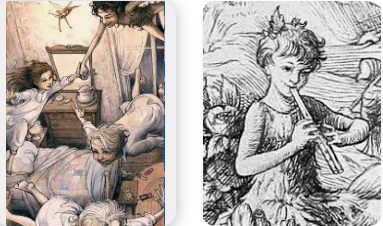
Barrie’s inspiration was deeply personal. His brother David died in a skating accident at the age of thirteen, forever preserved in family memory as the boy who would never grow older. This tragedy shaped Barrie’s imagination, casting Peter Pan not merely as a playful sprite but as a boy suspended in grief, mythologized as eternal.
The mythology of Neverland draws from older traditions. Celtic folklore spoke of Tír na nÓg, a timeless realm where youth and beauty never fade, but from which return meant rapid aging and death. Like those legends, Neverland is seductive and perilous—a place where time is arrested, but growth and mortality are denied.
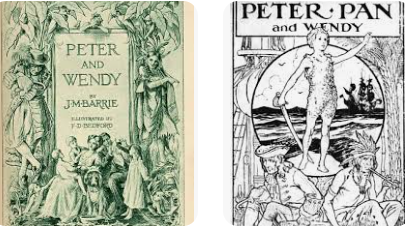
Peter himself echoes medieval folklore of changelings and otherworldly children, including the Green Children of Woolpit, mysterious siblings who appeared in 12th-century England speaking an unknown language and seemingly untouched by ordinary time. Such tales reflect humanity’s fascination with beings who exist outside the life cycle, neither fully alive nor fully mortal.
The Lost Boys carry an even darker resonance. They were inspired by the Llewelyn Davies boys, whom Barrie unofficially adopted after their parents died. Neverland’s band of abandoned children reflects real Edwardian anxieties: fractured families, orphanhood, and the fear of children slipping beyond social order. In Barrie’s vision, Neverland is not simply fantasy—it is an island of the forgotten.
Wendy Darling represents the era’s expectations placed upon young girls. While Peter resists adulthood, Wendy is drawn toward domesticity, motherhood, and responsibility, embodying Victorian and Edwardian ideals of feminine duty. Her role as caretaker to the Lost Boys highlights how quickly childhood was expected to transform into responsibility.
Even Captain Hook, often portrayed as comic villainy, reflects deeper cultural archetypes. Pirates were symbols of lawlessness and death at sea, and Hook’s obsession with time—the ticking crocodile—mirrors Peter’s denial of it. Hook fears time; Peter escapes it entirely.
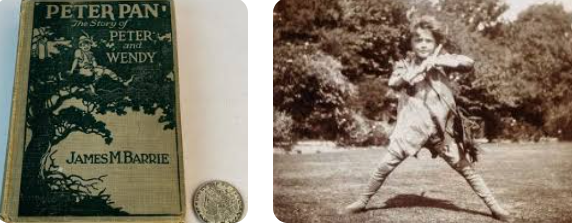
In gothic interpretation, Peter Pan becomes a figure of haunting stillness: a boy who refuses entropy, refuses aging, refuses closure. He is childhood embalmed in narrative, preserved forever in the amber of story. Neverland, then, is not simply a playground, but a mausoleum of memory—where children never die because they never truly live beyond a single frozen moment.
Peter Pan endures because he speaks to a universal fear and desire: to escape time, yet to remain human. In his shadowed wings, we see both the dream of eternal youth and the quiet horror of never moving forward.
In the end, Peter Pan is less a fairy tale hero and more a literary ghost—a boy forever hovering between myth and mourning, between joy and the stillness of remembrance.
#PeterPan #GothicLiterature #FairyTaleOrigins #EdwardianHistory #LiteraryMyths #Neverland #DarkAcademia #GothicDustDiaries #Barrie #ChildhoodMyths #LiteraryHistory #GothicInterpretation #MythAndMemory