
Town Where It’s "Illegal" 2 Die
The Chilling Truth Behind Longyearbyen
https://youtube.com/shorts/rifvwCbN0cc
It sounds like the opening line of a gothic novel.
Somewhere in the frozen reaches of the Arctic, there is a town where dying is said to be against the law.
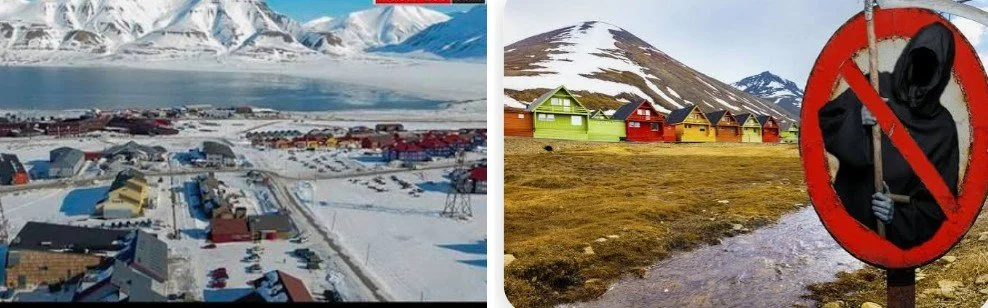
The statement is repeated so often that it has become one of the world's most enduring travel legends. While technically untrue, the reality behind the story is every bit as fascinating.
High above the Arctic Circle lies Longyearbyen, the largest settlement on Norway's remote Svalbard archipelago. Winters here are long, dark, and unforgiving. Temperatures remain well below freezing for much of the year, and the earth itself is permanently frozen in a layer known as permafrost.
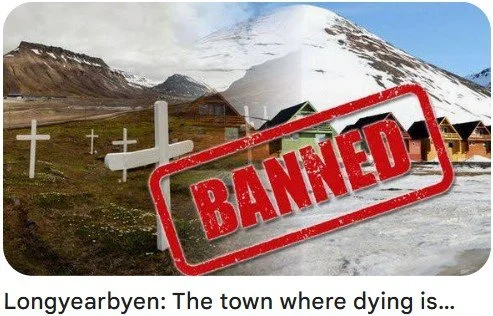
For most communities, a cemetery is a place where the dead slowly return to the earth. In Longyearbyen, however, nature follows different rules.
Because the ground rarely thaws, bodies buried there do not decompose in the normal way. More than a century ago, researchers discovered that human remains buried during the 1918 influenza pandemic had been remarkably well preserved by the frozen soil. Even traces of the virus remained detectable decades later, raising concerns about what ancient diseases the Arctic might continue to preserve.
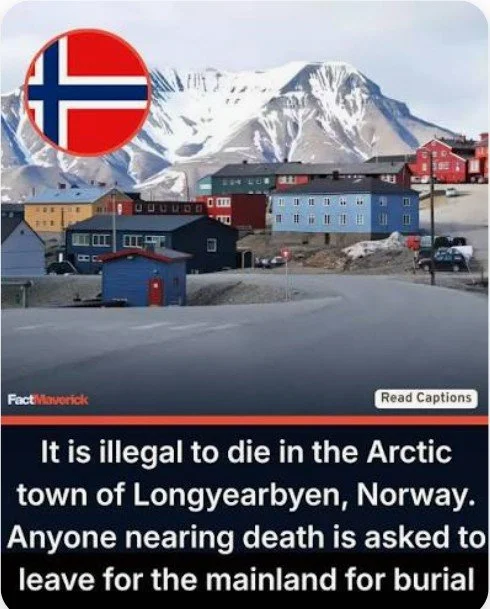
As a result, Longyearbyen gradually stopped accepting new burials except in extraordinary circumstances. Residents who become terminally ill are often transferred to mainland Norway when their medical condition allows. The goal is not to prevent death, but to ensure that proper medical care and traditional burial arrangements can be provided elsewhere.
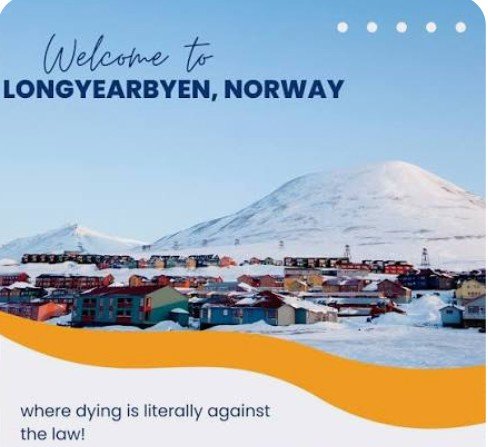
This practical policy slowly transformed into a curious legend. Visitors began hearing that "it is illegal to die in Longyearbyen." It is a memorable phrase, but one that oversimplifies reality.
No law can forbid death. Instead, geography, climate, and public health combined to create one of the world's most unusual administrative practices.
Longyearbyen is not unique in adapting to an extreme environment. Throughout history, communities have rewritten customs to survive deserts, mountains, islands, and frozen wilderness. Yet few examples capture the imagination quite like this Arctic settlement, where the frozen earth refuses to let nature complete one of its oldest cycles.
There is something strangely poetic about the idea.
In most places, time slowly erases every trace of us. In Longyearbyen, time itself seems suspended beneath the ice, preserving echoes of lives long passed. The town reminds us that even death, perhaps humanity's only certainty, can be shaped by the landscapes we inhabit.
Sometimes the world's strangest stories are not myths at all. They are simply ordinary truths viewed through extraordinary circumstances.
And that may be even more haunting than the legend itself.