
MINDS NOT OUR OWN
The Intelligence Hiding in the Animal Kingdom
For centuries, the raven has carried an uneasy reputation.
It appears in mythology as messenger and trickster, circles battlefields in old stories, perches among gravestones in Gothic imagery, and—thanks in no small part to Edgar Allan Poe—has become almost inseparable from our idea of the dark and mysterious.
The crow fares little better. Black-feathered, watchful and frequently gathered in noisy groups, it has inspired everything from superstition to the wonderfully ominous name for a gathering of them: a murder.
But perhaps our ancestors noticed something more unsettling than black feathers.
Perhaps they noticed that these birds were watching us back.
The Crow Knows Your Face
Researchers have discovered that American crows can recognize individual human faces—and remember the ones they associate with danger.
In a University of Washington experiment, researchers wore distinctive masks while capturing and banding wild crows. Later, people wearing those same “dangerous” faces were scolded and mobbed by crows, while other faces were largely ignored. The response persisted for years and spread beyond the birds originally captured, demonstrating that information could be socially transmitted through the crow community.
In other words, you don't necessarily have to offend every crow in town personally.
They can tell one another about you.
That almost sounds like folklore.
It isn't.
And facial recognition is only the beginning.
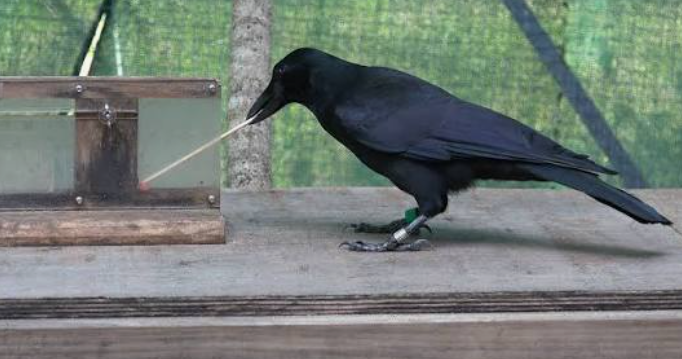
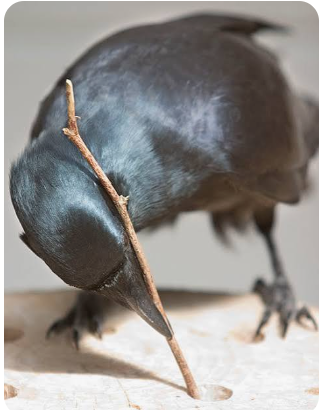
New Caledonian crows manufacture tools in the wild, deliberately shaping twigs and plant material into implements that help extract prey. Researchers have even found that young birds raised without demonstrations spontaneously begin making and using basic tools, suggesting that part of the ability is innate rather than simply copied from another bird.
Then scientists presented New Caledonian crows with an entirely unfamiliar problem.
The available pieces were individually too short to reach food.
Several birds figured out that the pieces could be joined together to make a longer tool. One crow, appropriately named Mango, eventually constructed tools consisting of three and even four pieces. The researchers were careful not to claim that the birds were necessarily reasoning exactly as humans do—but the behavior demonstrated remarkable flexibility in solving a problem they had never encountered before.
No hands.
No workshop.
Just a beak, a problem—and apparently an idea.
And Then There Are Ravens
Crows and ravens belong to the corvid family, a group whose cognitive abilities have repeatedly surprised researchers.
Ravens can solve complex problems, remember social relationships and adjust their behavior according to what other individuals may have seen. Experiments have also produced evidence consistent with planning for future situations—abilities once considered much closer to the exclusive territory of humans and other primates.
Perhaps that is why the raven has occupied such a peculiar place beside us for so long.
We turned it into an omen.
A messenger.
A keeper of secrets.
Maybe we sensed intelligence long before we had experiments capable of measuring it.
Too Smart to Keep?
There is another curious fact surrounding these birds.
In the United States, you generally cannot walk outside, capture an American crow and decide it would make an interesting pet. Native migratory birds are protected under federal law, and possession requires appropriate authorization or an applicable exception.
But the tempting internet explanation—they're so intelligent we're forbidden from keeping them—isn't really true.
The laws are about wildlife conservation and protecting native birds, not preventing humanity from assembling an army of exceptionally clever crows.
Probably for the best, nevertheless.
We have already established that they remember faces.
Intelligence Without Feathers
Corvids aren't alone.
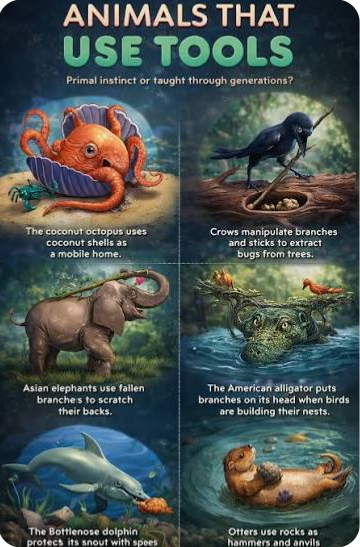
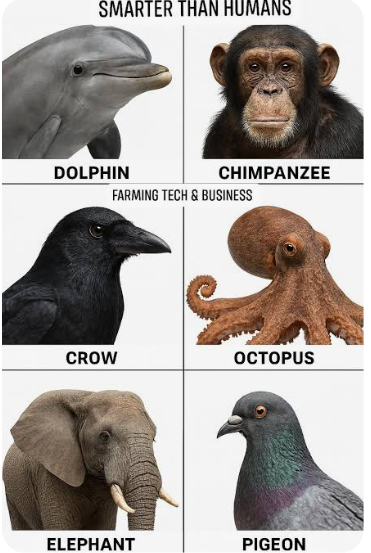
An octopus has a radically different nervous system from ours, with much of its neural processing distributed through its arms. Yet octopuses solve puzzles, manipulate objects, navigate mazes and have become notorious escape artists in aquariums.
Elephants maintain complicated social relationships, cooperate with one another and show extraordinary memory. They also display striking behavior around dead members of their species, sometimes returning to remains and examining bones.
Dolphins recognize individuals, learn from one another and live within socially transmitted behavioral traditions. Some populations develop techniques that neighboring groups do not use—behavior researchers can reasonably describe as forms of animal culture.
Parrots can do far more than imitate sounds. Research with some species has demonstrated abilities involving categories, quantities, shapes and labels.
And our closest relatives, the great apes, use tools, deceive, cooperate, learn socially and sometimes pass learned behaviors through communities.
None of these animals is simply a lesser version of us.
That may be the more interesting point.
Minds Not Our Own
For a very long time, humans measured intelligence by resemblance to ourselves.
Language like ours.
Tools like ours.
Problems solved the way we would solve them.
But evolution never promised that intelligence would take only one form.
A crow doesn't need to think like a human to recognize the person who threatened it years ago.
An octopus doesn't need a human-like brain to solve a puzzle.
An elephant doesn't need words to remember.
And a raven does not need to say Nevermore for us to wonder what might be happening behind those black eyes.
Perhaps the animal kingdom isn't filled with creatures waiting to become more like us.
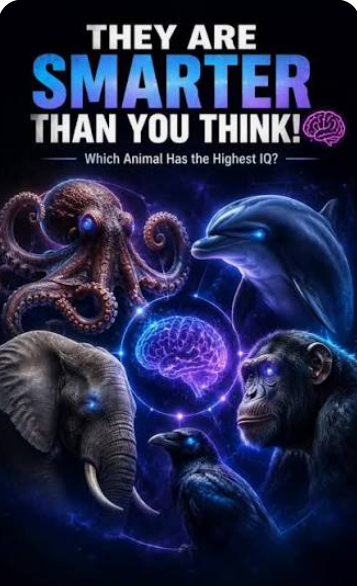
Perhaps it is filled with minds not our own—different solutions to the same ancient problems of remembering, learning, surviving, communicating and understanding the world.
And somewhere above us, perched quietly on a branch, a crow may be looking down.
If you've met before—
there is a surprisingly good chance it knows.
#MindsNotOurOwn #Crows #Ravens #Corvids #CrowIntelligence #RavenIntelligence #AnimalIntelligence #NewCaledonianCrow #AnimalMinds #AnimalBehavior #AnimalCulture #Octopus #Elephants #Dolphins #Parrots #GreatApes #LivingHistory #Echoes #GothicDustDiaries