
WHEN THE ANCIENT WORLD LOOKS STRANGELY MODERN
What do we see when we look at the past?
Look at an ancient carving long enough and something peculiar can happen.
A shape carved thousands of years ago suddenly looks familiar.
A helicopter.
A light bulb.
A spacecraft.
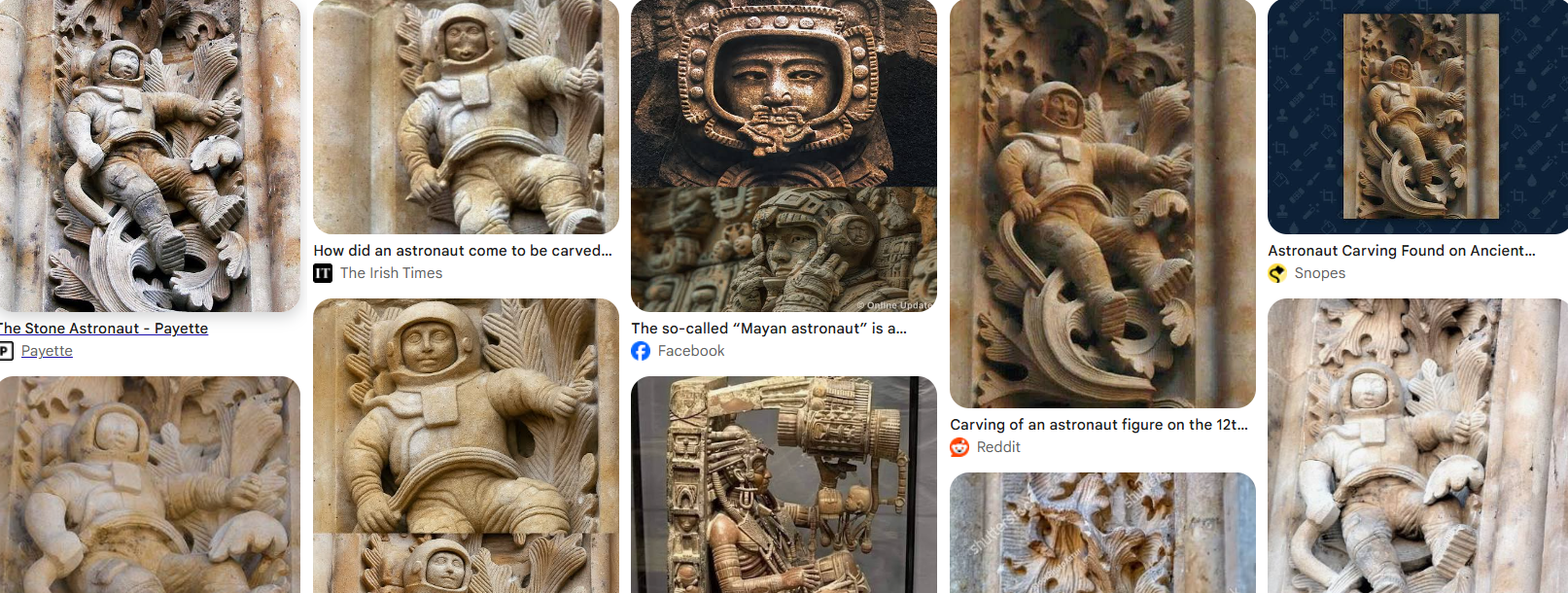
Perhaps even an astronaut.
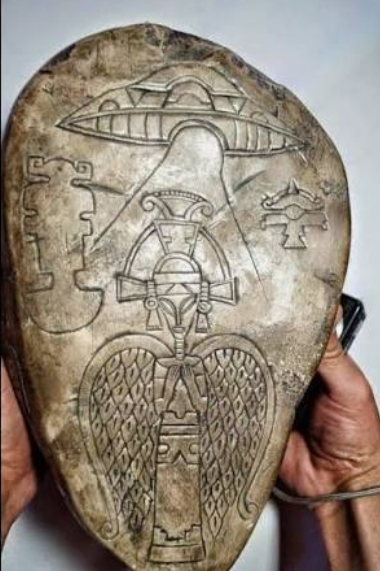
Television programs such as Ancient Aliens have built an enduring question around these similarities: Could some of the images, stories and structures left by ancient civilizations represent encounters with technology—or beings—that their creators could not otherwise have known?
Archaeologists generally offer very different explanations.
But the images themselves are real.
And sometimes what our modern eyes see in them is remarkably difficult to unsee.
The Helicopter at Abydos
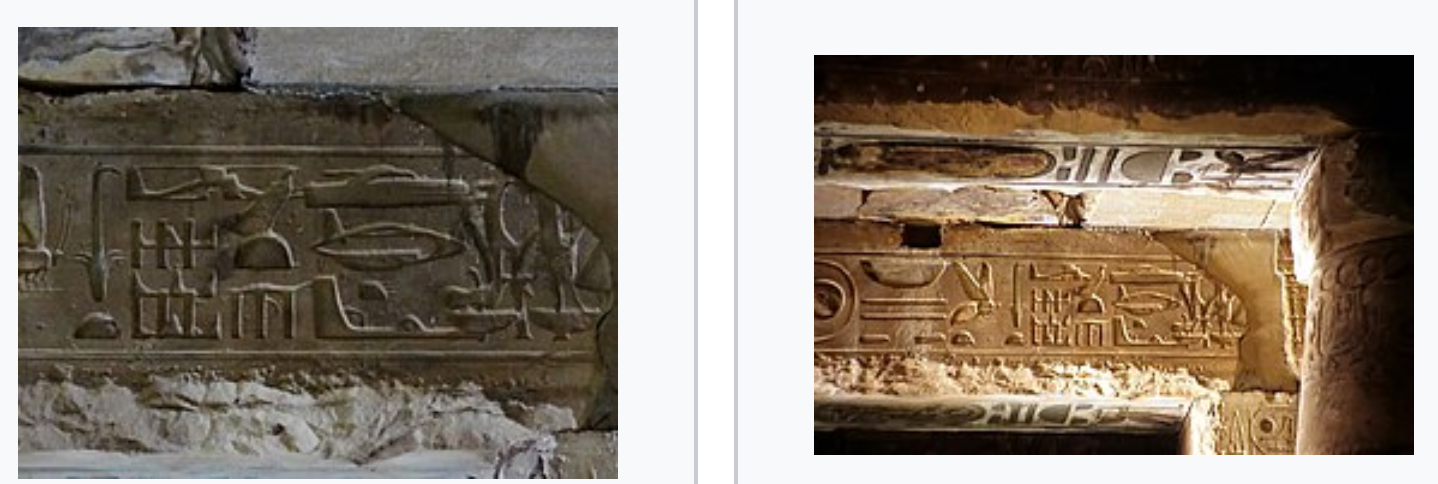
High inside the Temple of Seti I at Abydos, Egypt, is a group of hieroglyphs that has become famous on the internet.
One shape bears an uncanny resemblance to a modern helicopter. Nearby forms have been compared to an airplane, submarine or other mechanical vehicles.
Seen through twenty-first-century eyes, the resemblance is striking.
But there is another explanation—and it has nothing to do with aircraft.
The inscription was altered after Seti I's reign. Earlier hieroglyphs were covered and new ones associated with Ramesses II were carved over them. As the material covering the original inscription deteriorated over thousands of years, portions of both sets of hieroglyphs became visible simultaneously.
The result is essentially an ancient visual overlap: two different inscriptions combining into shapes neither inscription originally contained.
Our eyes supply the helicopter.
The Ancient Egyptian “Light Bulb”
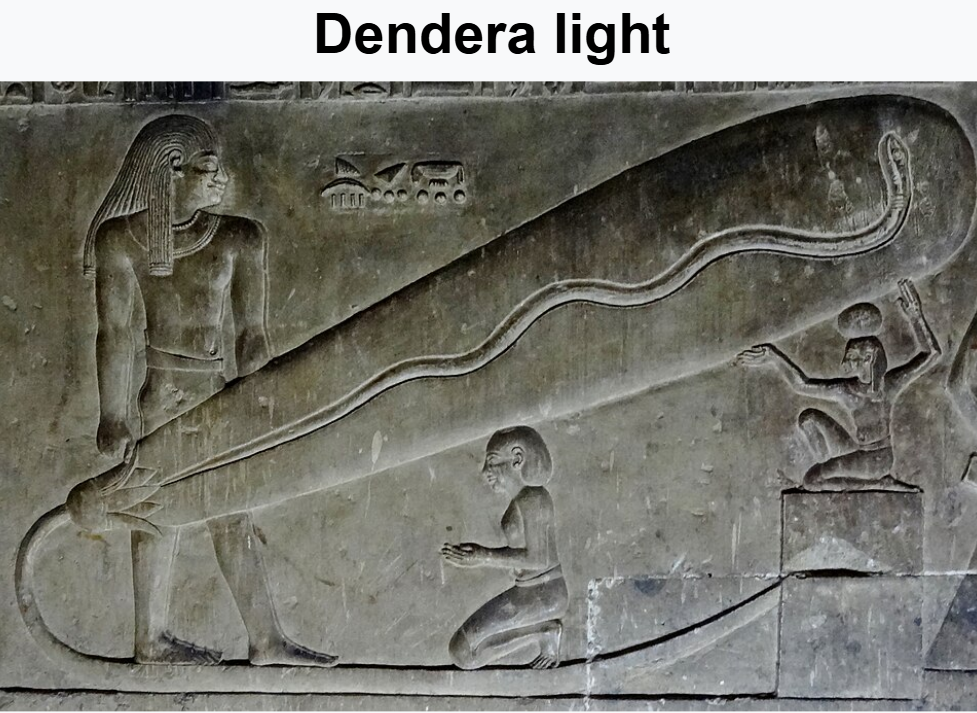
At the Temple of Hathor at Dendera is another extraordinary image.
An elongated oval surrounds a serpent. At one end is what appears, to modern eyes, almost like the base of a large bulb. A line extends beneath it. A pillar-like object stands nearby.
Put beside an early electrical tube and the similarity can be startling.
This has inspired claims that ancient Egyptians may have possessed some form of electrical lighting.
Egyptologists read the scene very differently.
The surrounding inscriptions and imagery identify familiar elements of Egyptian religious symbolism: the god Harsomtus represented as a serpent emerging from a lotus, along with the djed pillar and imagery connected with creation and rebirth.
There is also no established archaeological evidence showing that ancient Egyptians possessed an electrical lighting system.
Yet remove the cultural context, show the carving to modern eyes, and it is easy to understand why the comparison began.
It really does look familiar.
The Maya King Who Became an Astronaut
Then there is the magnificent sarcophagus lid of the Maya ruler K'inich Janaab' Pakal at Palenque in present-day Mexico.
Turn the image a certain way and Pakal appears almost to be seated inside a machine. His hands seem positioned near controls. His body leans forward. Elaborate imagery surrounds him.
To proponents of the ancient-astronaut theory, the scene has been compared to a person piloting a spacecraft.
Within Maya iconography, however, the scene tells another story.
Pakal is shown within a complex religious image associated with death, rebirth, the maize god and the journey between worlds. The Smithsonian's National Museum of the American Indian describes the sarcophagus lid as depicting Pakal's rebirth as the maize god and the eastern Sun.
Same carving.
Entirely different ways of seeing it.
Perhaps the Mystery Is Us
There is a word for our tendency to recognize familiar forms in ambiguous images: pareidolia.
It is why we see faces in clouds, animals in rock formations and expressions in the front ends of automobiles.
And perhaps it explains at least part of our fascination with ancient images that resemble modern technology.
We cannot look at the past without bringing the present with us.
Someone living three thousand years ago could stare at the Abydos carving for a lifetime and never see a helicopter.
We see one almost immediately.
Someone unfamiliar with Egyptian mythology might look at the Dendera relief and see machinery before ever seeing a serpent emerging from a lotus.
And once someone tells you that Pakal looks like an astronaut operating a spacecraft, it becomes surprisingly difficult not to see that too.
That does not make the ancient-astronaut interpretation historical fact.
But it does make the phenomenon fascinating.
Because these images reveal something not only about ancient civilizations—but about us.
Human beings are pattern seekers. We compare the unknown with the familiar. We interpret what we cannot immediately explain through the world we already understand.
Ancient people did much the same thing when they looked upward.
Comets became omens.
Planets became gods.
Unusual lights became messages from the heavens.
Today we look backward and sometimes transform their gods, symbols and stories into spacecraft, machines and visitors from other worlds.
Perhaps someday people thousands of years from now will uncover images from our civilization and confidently explain what we meant.
Perhaps they will even be right.
Or perhaps they will see something we never intended to put there at all.
That may be the most intriguing possibility.
Sometimes the mystery isn't what the ancients saw when they looked toward the heavens.
It's what we see when we look back at them.
#Celestial #AncientAliens #AncientAstronauts #AncientEgypt #Abydos #Dendera #Palenque #Pakal #Maya #Hieroglyphs #AncientMysteries #Archaeology #Pareidolia #AncientHistory #MysteriesOfThePast #GothicDustDiaries