
Siouxsie and the Banshees
A Gothic Rock Portrait

Emerging from the bleak energy of 1976 London, Siouxsie and the Banshees didn’t simply enter the early post-punk scene — they carved a shadowed passage through it. At a time when punk raged outward, they turned inward, shaping something colder, more deliberate, and infinitely more enduring.
At the center stood Siouxsie Sioux — not merely a vocalist, but a presence. Her voice did not plead. It invoked. It did not soothe. It summoned. Where others shouted, Siouxsie hovered, her vocals drifting like candle smoke through abandoned rooms: controlled, commanding, and unsettlingly elegant.
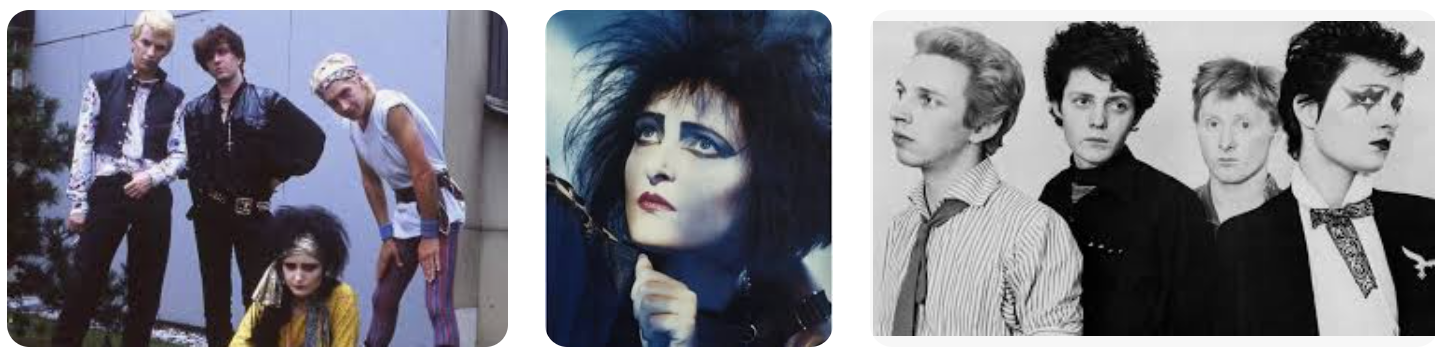
The band’s earliest work pulsed with angular guitars and ritualistic rhythms, a sound that felt raw yet intentional. But it was with 1981’s Juju that they fully inscribed themselves into the dark canon. The album does not rush. It stalks. Tribal drums throb like a pulse beneath stone floors, while guitars spiral and coil rather than comfort. This is music that understands shadow not as something to escape, but as a place of beauty.
Tracks such as Spellbound shimmer with kinetic energy and spectral tension — a dance performed under moonlight, aware of something unseen watching from the edges. Arabian Knights weaves mystery and seduction, while Cities in Dust carries apocalyptic imagery wrapped in rhythm, reminding us that civilizations crumble, but echoes endure. Throughout, Siouxsie’s lyricism reads like poetry from the margins of night: surreal, enigmatic, and unafraid of discomfort.
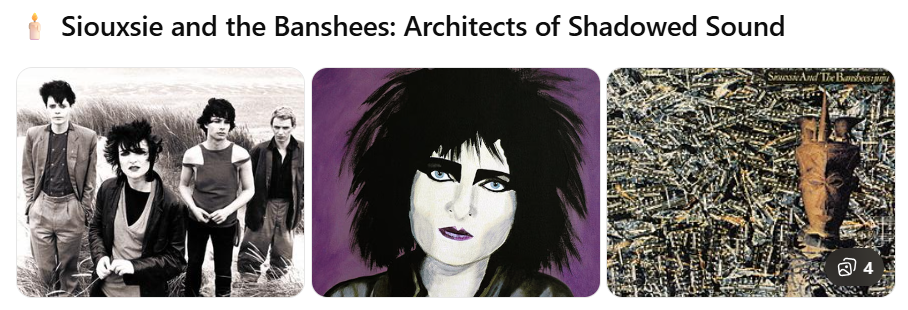
Unlike many of their contemporaries, Siouxsie and the Banshees refused confinement to a single sound. Their evolution moves effortlessly between brittle minimalism and lush, atmospheric landscapes. They flirted with the avant-garde and the spectral, yet through every transformation there remained a consistent pulse — an embrace of both elegance and the macabre.
Long before gothic became a label, before it was packaged as an aesthetic or commodified into a marketplace, Siouxsie and the Banshees were already living inside its bones. They understood instinctively what gothic culture has always known: that darkness does not need to announce itself. It lingers. It breathes. It waits.
To admirers of gothic sensibility, they are not merely pioneers. They are poets of the dark — charting a space between punk urgency and a yearning for the uncanny. Their influence extends far beyond their era, reverberating through generations of artists who found solace, power, and beauty in shadow.
What makes Siouxsie and the Banshees timeless — and so naturally at home within Gothic Dust Diaries — is their reverence for mood. This is music for those who find poetry in decay, elegance in ruin, and truth in the things that refuse to disappear.
Songs That Fit the Gothic Theme
Here’s a curated list of gothic-aligned tracks from their catalog.

Spellbound — urgent riffs meet spectral vocals
Arabian Knights — hypnotic, mysterious, and seductive
Night Shift — brooding atmosphere and minor keys
Christine — fractured psyche in sonic form
Vision Thing — darker, sleek post-punk edge
Cities in Dust — apocalyptic imagery with rhythmic chills
The Last Beat of My Heart — elegiac and haunting
Halloween — aptly titled, moody and evocative
Voodoo Dolly
#GothicDustDiaries #SiouxsieAndTheBanshees #DarkWave #GothRock #postpunk #gothicmusic #musichistory #Juju #spellbound #gothplaylist #darkaesthetic