
OUT WITH THE OLD, IN WITH THE NEW
A GOTHIC PASSAGE INTO THE YEAR

Long before champagne corks split the air and glittering countdowns flashed across glowing screens, the turning of the year was something darker, quieter, and far more symbolic. The phrase “out with the old, in with the new” did not begin as a cheerful slogan — it began as a reckoning.

The earliest recorded New Year celebrations trace back over 4,000 years to ancient Mesopotamia. For them, the new year arrived not in winter, but in spring — a season of rebirth pulled from the soil itself. The old year was not celebrated away; it was judged, buried, and replaced. Debts were settled. Promises were sworn. Kings reaffirmed their right to rule. The past had to be accounted for before the future could begin.
As centuries passed, civilizations layered meaning upon meaning. The Romans gave us January, named for Janus — the two-faced god who looked both backward and forward. Janus did not smile. One face stared into memory, regret, and consequence. The other faced the unknown. The new year, then, was not a clean slate — it was a threshold, guarded by a god who remembered everything.
This is where the imagery of the old man and the baby was born.
The old man represents the year that has aged, worn thin by time. He carries the weight of mistakes, victories, grief, and survival. His beard is long because time has passed. His back bends because it always does. He is not evil — but he must go.
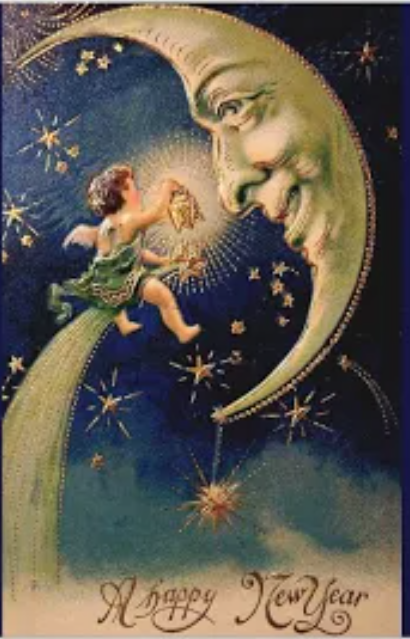
The baby, by contrast, is not innocent because it is pure — it is innocent because it has not yet been tested. The new year arrives fragile, unnamed, unmarked. It carries possibility, but no guarantees. In gothic truth, the baby does not erase the old man — it replaces him. Time does not heal; it continues.
Medieval Europe embraced this symbolism with a darker reverence. Church bells tolled at midnight not only to welcome the new year, but to mark the death of the old one. The turning of the calendar was a memento mori — a reminder that time consumes everything, including us.
Even today, the rituals remain, though softened by noise and light. We burn calendars. We make resolutions we half-believe. We toast to “new beginnings” while dragging the old year behind us like a shadow. The gothic truth is this: the new year does not arrive clean. It arrives stained with memory.
And yet — we step forward anyway.
Because the turning of the year is not about forgetting. It is about choosing to continue. Standing at the edge of time. Letting the old man rest. Lifting the child into the dark. And walking on.
#newyearorigins #gothichistory #darktraditions #Janus #outwiththeold #inwiththenew #Symbolism #ancientrituals #timeandmemory #gothicdustdiaries